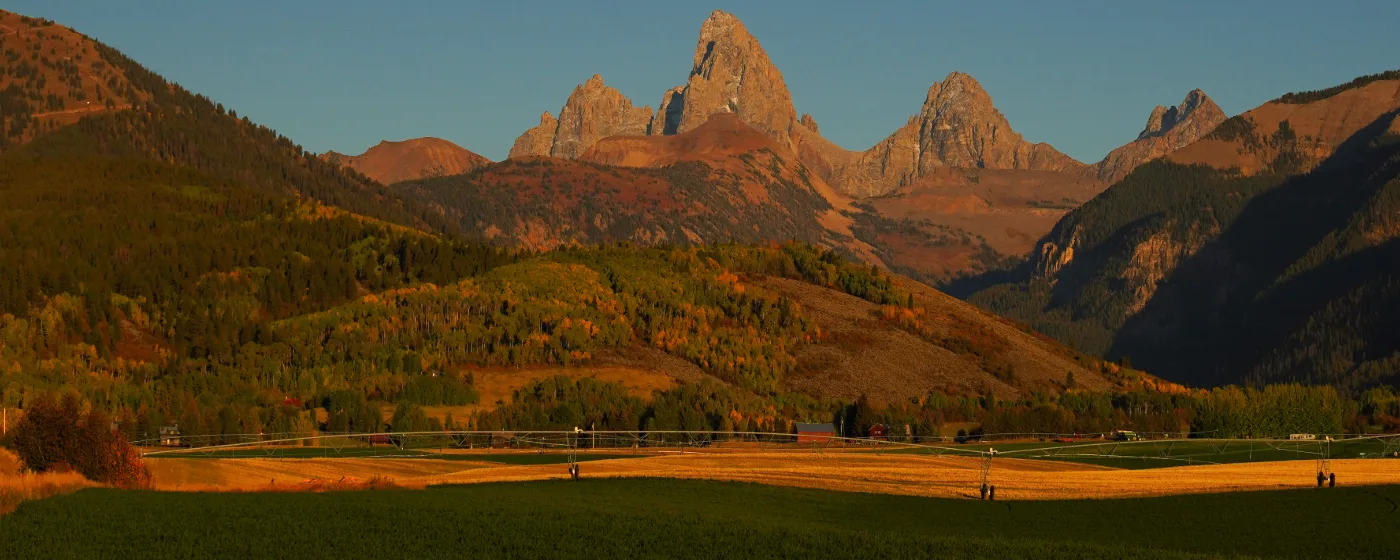
Sugar City surprises people. At first glance it reads as a quiet eastern Idaho farming town — and in many ways it still is, with grain elevators visible from nearly every street and open fields starting where the sidewalks end. But underneath that rural surface, this 1.99-square-mile city along U.S. Highway 20 and State Highway 33 is moving faster than its population of roughly 2,115 suggests. The Fort Henry Junction interchange — where those two highways cross — is actively attracting new commercial and industrial development, and Kartchner Homes has already broken ground on Teton Island Estates, the city's first purpose-built new-construction subdivision with Teton Range views. Choosing the right neighborhood here means understanding which version of Sugar City you're buying into: the established core built around its 1903 company-town grid, or the new-growth edges taking shape around the highway corridors.
The Sugar-Salem Joint School District holds a B- rating, according to Niche, and it is the single institution that binds the whole community together — with Sugar-Salem High School arguably the city's most recognizable export. With 105 Idaho High School Activities Association state championships and three consecutive MaxPreps Cup wins for Idaho's best overall high school sports program (2018–2019–2020), Friday nights at Digger Drive carry real weight here. Major employment draws residents toward Rexburg, roughly ten minutes west on Highway 20, where BYU-Idaho and retail services dominate; larger retail is also a short drive away. Most households in Sugar City are young families or multigenerational agricultural families, with a median household income of $66,953. The people who move here are typically priced out of Rexburg's newer subdivisions, drawn to Sugar-Salem's sports reputation, or simply want more land per dollar than any larger Idaho city can offer.
The cost of living here sits noticeably below the U.S. average — the city's cost-of-living index is 89.0 — and the median list price of $434,000 (Movoto, March 2026) is meaningfully below what comparable new construction fetches in Rexburg proper. Day-to-day life is car-dependent by design; you will drive to Smith Park or Heritage Park for weekend recreation, drive to Rexburg for groceries and a sit-down meal, and drive thirty miles to Idaho Falls for anything resembling a regional shopping trip. Ole's Diner on N Austin Ave is the one place locals walk or drive to for a burger without leaving town — a June 2026 feature called it a fifteen-year Idaho favorite, and the lines on weekend mornings back that up.
Whether you're considering a move or just beginning to research the area, the sections below break down Sugar City's six neighborhoods, their price ranges and trade-offs, which areas suit which buyer types, common mistakes to avoid, and where renters are most likely to find inventory.
The Sugar City Reality
Sugar City's entire developed footprint fits inside roughly two square miles, so the meaningful divides here are not about distance — they're about era and orientation. The original 1903 company-town grid, anchored by Center Street running east-west and Railroad Avenue running north-south, defines the historic core. Streets in that grid are narrower, lots are smaller, and the homes are older. Everything built in the last decade — most visibly Teton Island Estates on the eastern edge — sits outside that grid entirely, on larger parcels with modern utility hookups and open sight lines toward the Teton Range.
The second dividing line is the Highway 20/33 interchange at Fort Henry Junction. Areas closest to that corridor are already feeling development pressure: new commercial pads, industrial tenants, and future residential projects are all concentrating there. Buyers who want quiet and privacy should orient toward the city's interior streets; buyers who want to be positioned for appreciation tied to commercial growth should look harder at the highway-adjacent edges.
School boundaries here are simple — virtually every residential street in Sugar City feeds into the same Sugar-Salem district, so chasing a boundary line is not the issue it is in larger cities. What does matter is walking proximity to Sugar-Salem High School on Digger Drive versus a drive across town, and whether a neighborhood's lot sizes and setbacks match what a buyer actually needs for gardening, livestock access, or a shop building — all common priorities for families moving here from surrounding agricultural communities.
Neighborhoods at a Glance
| Neighborhood | Best For | Price Range | Vibe |
|---|---|---|---|
| Teton Island Estates | Families Luxury Views | $480,000–$620,000+ | New construction, Teton views, open feel |
| Central Sugar City | Walkable First-Time | $320,000–$420,000 | Established grid, walkable to school and park |
| Railroad Avenue District | First-Time Value | $290,000–$380,000 | Historic character, civic energy, entry-level pricing |
| North Sugar City | Families Quiet Privacy | $350,000–$460,000 | Larger lots, rural edge, low traffic |
| South Sugar City | Commuter Value | $300,000–$400,000 | Highway-adjacent, practical, no-frills |
| West Center Street Area | First-Time Renter Walkable | $310,000–$400,000 | Mixed housing stock, closest to Rexburg corridor |

Best Neighborhood by Buyer Type
| Buyer Type | Best Neighborhood | Why |
|---|---|---|
| First-Time Buyer | Railroad Avenue District | Entry-level price points and improving civic investment make it the most accessible foothold in town. |
| Luxury Buyer | Teton Island Estates | Kartchner Homes' new-construction subdivision is the only area offering modern finishes, Teton views, and larger floor plans at one address. |
| Walkability Seeker | Central Sugar City | The original grid puts Heritage Park, Smith Park, Sugar-Salem High School, and Ole's Diner on N Austin Ave within a short walk of most front doors. |
| Families with Kids | North Sugar City | Larger lots give kids room to roam, traffic is minimal, and the rural buffer appeals to families coming from agricultural backgrounds. |
| Commuters | South Sugar City | Closest positioning to the Highway 20 corridor shaves a minute or two off the ten-minute Rexburg run every single workday. |
| Large-Lot Buyers | North Sugar City | The northern edge of town is where you'll find the widest setbacks and the most realistic chance of keeping a shop building or small agricultural operation. |
| Renters | West Center Street Area | The most varied rental inventory in the city sits along and just off West Center Street, within easy reach of the Rexburg commute. |
Looking to buy in Sugar City? Estimate your payment.
Enter your numbers to see an estimated monthly mortgage payment.
Estimate only. Excludes HOA fees and mortgage insurance. The interest rate above is a starting point, not a quoted rate — replace it with your own to see real numbers. Insurance is a flat placeholder, not a Sugar City quote.
Most Popular Neighborhoods in Sugar City
1. Teton Island Estates
Kartchner Homes built this subdivision on the city's eastern outskirts specifically to capture the demand for new construction that Rexburg's price ceiling was pushing out. Homes here list in the $480,000–$620,000+ range — Sugar City's highest — and the Teton Range views are genuine, not a marketing stretch. The catch: you are on the edge of town, which means more driving for anything, and construction activity next door could be a years-long reality as the subdivision fills in.
Best for: Move-up buyers who want new construction and panoramic views without Rexburg's price premium.
2. Central Sugar City
This is the walkable heart of the city — the blocks around Center Street and the original company-town grid where you can actually get to Heritage Park, Smith Park, and Sugar-Salem High School without starting a car. Homes range from $320,000–$420,000, reflecting the older stock and smaller lots, and deferred maintenance is common on properties that haven't been updated since the 1970s or 1980s. Buyers who want character and on-foot access will love it; buyers expecting move-in-ready condition at these prices need to look carefully at inspection reports.
Best for: Families and first-time buyers who prioritize on-foot access to parks and school over square footage.
3. Railroad Avenue District
Railroad Avenue runs north-south through the city's historic spine, and the blocks surrounding it carry the lowest price floor in Sugar City — roughly $290,000–$380,000. The Sugar Area Historical Society's planned depot museum on the west side of Railroad Avenue just south of Center Street is a genuine investment signal, but the area still has pockets of older, unimproved housing stock that can surprise buyers who expect finished interiors at these prices. The upside: if the civic and commercial energy catalyzing this corridor follows through, early buyers here will be glad they moved first.
Best for: Value-oriented buyers and first-time buyers comfortable with some renovation risk in exchange for the city's most affordable entry points.
4. North Sugar City
The northern end of town transitions quickly from residential streets to open agricultural land, which is exactly the point for many buyers here. Lots are larger, neighbors are fewer, and the $350,000–$460,000 price range buys considerably more square footage and outdoor space than the central grid. The honest downside is distance from everything — including Sugar-Salem High School on Digger Drive and Ole's Diner — and roads that can be rough in winter without the maintenance attention the core streets receive.
Best for: Families who want space, privacy, and room for a shop or garden without leaving city limits.
5. South Sugar City
South Sugar City's defining feature is its orientation toward the Highway 20 corridor, which makes Rexburg genuinely close — and also means some streets carry more through-traffic noise than the quieter northern or central neighborhoods. Prices in the $300,000–$400,000 range reflect that trade-off honestly; you get practical highway access and relatively affordable entry but give up the quiet-street feeling that draws many buyers to eastern Idaho in the first place. New commercial development at Fort Henry Junction could push values in this direction over time, but it will also bring more traffic.
Best for: Commuters to Rexburg and buyers who prioritize highway access over neighborhood quiet.
6. West Center Street Area
West Center Street is Sugar City's most varied stretch — a mix of rental properties, owner-occupied starter homes, and a handful of larger lots that haven't been subdivided yet. Prices run $310,000–$400,000, overlapping with the Railroad Avenue District, and the housing stock is similarly mixed in age and condition. The real draw is the direct shot west toward Rexburg, which keeps commute times honest, and the variety of housing types means renters and first-time buyers often find their best inventory options here before buyers in any other part of town.
Best for: Renters transitioning to ownership, first-time buyers, and anyone who makes the Rexburg commute daily.
Common Mistakes Buyers Make in Sugar City
Assuming Every Street Feels the Same
Sugar City is small enough that buyers routinely assume the whole city is interchangeable. It isn't. A home on a quiet interior block near Heritage Park feels completely different from one backing the Highway 20/33 corridor near Fort Henry Junction — and the commute noise, development pressure, and long-term neighborhood trajectory diverge significantly between those two locations. Drive your target street at 7 a.m. on a weekday before making an offer.
Chasing Square Footage Over Condition
The older housing stock in the Railroad Avenue District and Central Sugar City regularly tempts buyers with more square footage per dollar than Rexburg can offer. What listing photos rarely convey is deferred maintenance that accumulated across decades — aging mechanicals, uninsulated crawl spaces, and original windows that turn eastern Idaho winters into a heating bill problem. Skipping a thorough inspection on a sub-$380,000 home to win a multiple-offer situation is the mistake most buyers here say they would undo.
Underestimating the Car Dependency
Sugar City's walkability score is real only in a narrow sense — you can walk to school and the parks, but groceries and most services require a ten-minute drive to Rexburg. Buyers relocating from more urban markets consistently underestimate how much this compounds: every errand, every appointment, every school pickup that misses the bus runs through your vehicle. Budget and plan accordingly before assuming the cost-of-living advantage fully offsets it.
Buying on the Growth Story Without Verifying the Timeline
The Fort Henry Junction development is real, and the city's Planning and Zoning administrator has publicly described it as a future commercial hub for the upper valley. But "future" is doing a lot of work in that sentence. Buyers who pay a premium for South Sugar City parcels banking on rapid commercial uplift should understand that infrastructure buildout timelines in small Idaho cities routinely run two to four years longer than initial projections. The growth story is credible — the timeline is not guaranteed.
Best Areas to Rent in Sugar City
| Area | Ideal For | Typical Rent Range | Trade-off |
|---|---|---|---|
| West Center Street Area | Renters Commuters | $950–$1,150/mo | Most inventory but also most turnover; condition varies widely |
| Central Sugar City | Walkable Families | $1,000–$1,200/mo | Better condition, closer to parks, but units lease fast |
| Railroad Avenue District | First-Time Value | $850–$1,050/mo | Lowest rents in the city; some units are dated and unimproved |
| South Sugar City | Commuters | $950–$1,100/mo | Highway noise is a real factor; landlord-owned stock dominates |
| North Sugar City | Quiet Privacy | $1,050–$1,250/mo | Fewer available units; expect a wait for the right listing |
Sugar City's rental market runs tight by small-town standards — vacancy is low enough that good units lease quickly, and waiting for a preferred neighborhood can mean losing it to the next applicant. Renters who plan to transition to ownership within two or three years should focus on West Center Street and the Railroad Avenue District, where entry-level purchase prices are still within reach of a household actively building a down payment.

Local Expert Takeaway: Sugar City's neighborhoods are separated by era more than by geography. If you want new construction with Teton views and modern finishes, Teton Island Estates is the only place to look — and Kartchner Homes is still building. If you want the most on-foot access to Heritage Park, Smith Park, and Ole's Diner on N Austin Ave, the blocks surrounding Central Sugar City's original grid are your best bet. First-time buyers willing to do some work should look hard at the Railroad Avenue District, where the depot museum project signals coming civic investment and prices are still the city's most accessible. Whatever neighborhood you target, drive it on a weekday morning — Sugar City is small enough that you can see every corner of it in twenty minutes, and that twenty minutes will tell you more than any listing sheet.
Quick Takeaways & FAQs
✅ Sugar-Salem High School has won 105 IHSAA state championships, including 52 between 2017 and 2024 — Friday night athletics here are genuinely community-defining, not just a footnote.
⚠️ Sugar City is almost entirely car-dependent: groceries and most services require a drive to Rexburg, so the cost-of-living advantage shrinks faster than buyers from more urban markets expect.
📍 The Fort Henry Junction interchange at Highway 20 and State Highway 33 is actively attracting new commercial development — South Sugar City's proximity to that corridor is both its main selling point and its main source of traffic noise.
What is the most affordable neighborhood in Sugar City, Idaho?
Where should families with school-age children buy in Sugar City?
Is Teton Island Estates a good investment in Sugar City?
How is the rental market in Sugar City, ID?
What's the biggest mistake buyers make when choosing a neighborhood in Sugar City?
Moving to Idaho?
Tell us what you need help with and we'll connect you with local resources.
