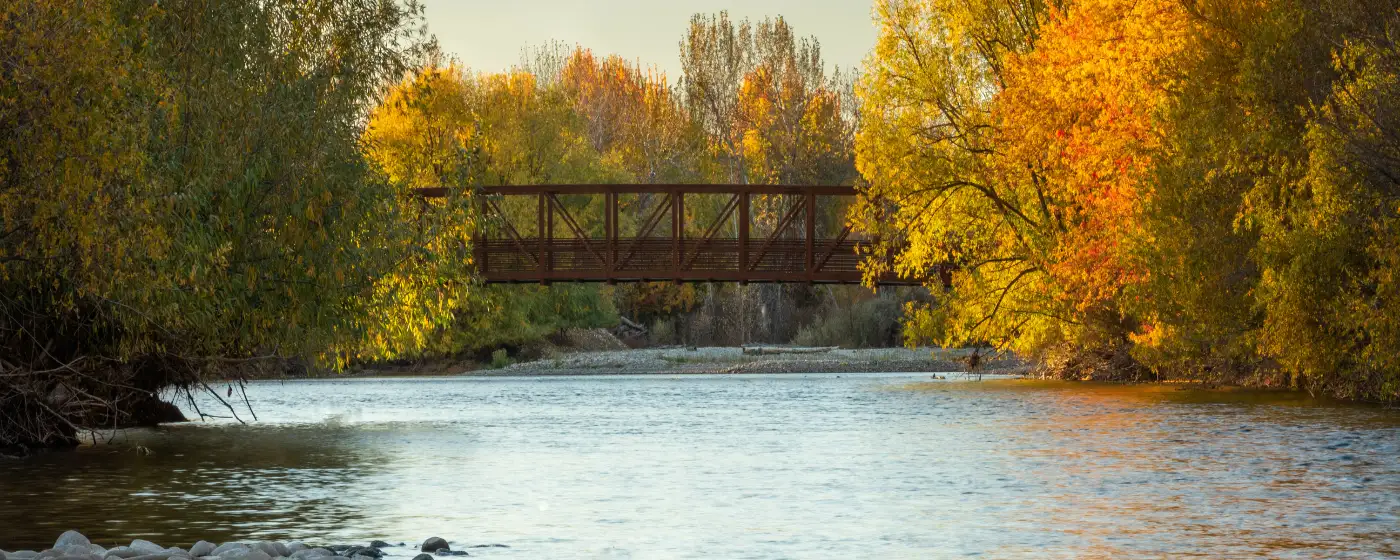
Most people who move to Garden City from California expect a smaller, quieter version of what they left behind. What they get is something harder to categorize: a compact city of roughly 13,000 people nearly encircled by Boise, with its own municipal government, an arts corridor along Chinden Boulevard, and a Boise River Greenbelt that runs right through it. Chinden Boulevard itself is named for a portmanteau of "China" and "garden," a nod to the Chinese immigrant market gardeners who farmed this stretch of the Treasure Valley — a history most new arrivals discover only after they've signed the papers. The drive to downtown Boise takes about five minutes. The psychological distance from coastal California feels considerably larger.
The economic case for the move is real, not just marketing. Garden City sits inside Ada County, which added more than 10,000 residents in 2025 alone — and the housing cost differential is the single biggest driver. The California statewide median sale price hit $843,390 in Q1 2026. Garden City's typical home value was $474,544 (Zillow Home Value Index, April 2026) — a gap large enough to change what financial decade you're in. Layer on Idaho's flat 5.3% state income tax against California's top marginal rate of 13.3%, and for mid-to-high earners the math shifts fast. The city is zoned inside the Boise School District, which holds an A- rating, according to Niche, so families with school-age children aren't trading down academically to make the numbers work.
Daily life in Garden City runs along the Boise River Greenbelt and the Chinden Corridor, where artists' studios, craft distilleries, and wine tasting rooms have steadily replaced light-industrial tenants since the early 2010s. Bardenay Distilling on W. Chinden Blvd — a full restaurant and distillery — is a good shorthand for the city's current personality: local, unpretentious, and a little unexpected. There's no Trader Joe's inside the city limits; the nearest is across the border in Boise. Groceries, utilities, and transportation costs are meaningfully below what most Californians pay, though the full breakdown lives on the cost-of-living page. Winters are colder and drier than anywhere on the California coast, and summer smoke from regional wildfires is a real part of August life here.
Whether you're weighing a remote-work relocation, chasing equity after selling a California home, or just looking for somewhere that costs less and crowds less, the sections below break down the California-to-Idaho comparison on home prices, taxes, and lifestyle — plus what the move actually feels like six months in.
The Home Price Reality: What Your California Equity Buys Here
The number that stops most California buyers mid-scroll: Garden City's typical home value was $474,544 (Zillow Home Value Index, April 2026). California's statewide median sale price for Q1 2026 was $843,390. That's not a rounding difference — that's a different tier of housing market entirely.
What the Gap Actually Means
If you sold a median California home and bought at Garden City's typical price, you'd close with a meaningful equity cushion before you've unpacked a box. Many California sellers arrive here able to put down 30–40% or more, which changes monthly cash flow substantially. That said, Garden City is not the cheapest entry point in the Treasure Valley — the city's neighborhoods range from the artsy, walkable River District to quieter corridors near the Expo Idaho fairgrounds, each with its own price character.
The city's effective property tax rate is 0.52% — below California's statewide effective rate of approximately 0.7%, and well below the national median of 0.89%. On a home at Garden City's typical value, that rate keeps annual property tax meaningfully lower than most California owners are accustomed to paying on a comparable purchase. Idaho does not cap assessed value growth the way California's Proposition 13 does, so your tax basis won't be frozen — but the rate itself is genuinely low.
The Rental Picture for Arrivals Who Aren't Buying Yet
If you're renting while you orient yourself, Idaho rents run meaningfully below California rates at every bedroom count — which buys you time to learn the market without burning through savings. Garden City proper is a small city; most rental inventory worth knowing about sits along the Chinden Corridor or within a short distance of the Greenbelt. The full rent breakdown is on the cost-of-living page.
| Metric | Garden City, ID | California (Statewide) |
|---|---|---|
| Typical/Median Home Price | $474,544 (ZHVI, Apr 2026) | $843,390 (median sale, Q1 2026) |
| Effective Property Tax Rate | 0.52% | ~0.70% |
| Rent vs. California | Meaningfully lower across all bedroom counts | Among highest statewide averages in the U.S. |
| Prop 13-Style Assessment Cap | No | Yes (Proposition 13) |
| Home Price vs. National Median | Below national median | Significantly above |
| Time to Boise Core | ~5 min | N/A |
* ZHVI = Zillow Home Value Index.
One thing California buyers consistently underestimate: the Boise-area market moves quickly when inventory is tight. Coming in with California equity and no contingency chain is a real competitive advantage — but it doesn't replace knowing the neighborhoods before you make an offer.
Taxes: The Idaho vs. California Breakdown
Tax savings are the most-cited reason Californians cite for this move, and in most cases the savings are real. But the picture is more nuanced than the headline numbers suggest — and one threshold in particular is worth knowing before you assume you'll automatically come out ahead.
State Income Tax: Flat vs. Progressive
Idaho moved to a flat 5.3% state income tax on all taxable income, effective January 1, 2025, scrapping its previous bracket system. California runs nine brackets from 1% to 12.3%, plus a 1% Behavioral Health Services Tax on income above $1 million — producing a 13.3% top effective rate with no Idaho equivalent.
The crossover point matters: at approximately $81,000 in taxable income, Idaho's flat rate and California's progressive brackets roughly break even. Below that threshold, some California earners actually pay less state income tax at home than they would under Idaho's flat rate. Above it — and especially well above it — Idaho saves real money. For a household earning $200,000 or more, the differential is substantial on an annual basis.
SDI and the Payroll Costs Californians Forget to Count
California's State Disability Insurance (SDI) runs at 1.3% in 2026 with no wage cap — that cap was eliminated in 2024. At $500,000 in W-2 wages, that's approximately $6,500 per year coming out of a paycheck that Idaho simply doesn't take. Idaho has no SDI equivalent. For dual-income households with high W-2 earnings, this line item alone is worth calculating before the move.
Sales Tax and the Grocery Credit
Idaho's statewide sales tax is 6%, below California's 7.25% base rate (which climbs higher with local additions in many California cities). Idaho does tax groceries at the full 6% — California exempts most food — but Idaho offsets this with a refundable Grocery Tax Credit of $155 per person per year, raised from $120 in the 2025 legislative session. For a family of four, that's $620 back annually.
| Tax Category | Garden City / Idaho | California |
|---|---|---|
| State Income Tax Structure | Flat 5.3% (all income) | Progressive, 1%–12.3% + 1% surcharge over $1M |
| Top Marginal Rate | 5.3% | 13.3% |
| Income-Tax Crossover Point | ~$81,000 taxable income (below: CA may be lower; above: ID wins) | |
| State Disability Insurance | None | 1.3%, no wage cap (~$6,500/yr at $500K wages) |
| Statewide Sales Tax Base | 6% | 7.25% (higher with local additions) |
| Grocery Tax | 6% (offset by $155/person refundable credit) | Exempt (most food) |
| Property Tax Rate (effective) | 0.52% | ~0.70% |
| Tax Foundation Competitiveness Rank | 9th nationally (2026) | Not in top 10 |
Idaho ranks 9th on the Tax Foundation's 2026 State Tax Competitiveness Index. That ranking reflects both the flat income tax structure and the absence of an estate tax, capital gains surcharge, or SDI-equivalent payroll deduction.
What Californians Often Miss
Idaho does not have Proposition 13-style assessed-value protection. If you buy here and the market appreciates — which it has, substantially, since 2019 — your assessed value can rise with it, and your property tax bill follows. The rate is low; that doesn't mean the bill stays flat forever. Run the scenario on purchase price, not on the current owner's tax bill.
What Daily Life Actually Looks Like After the Move
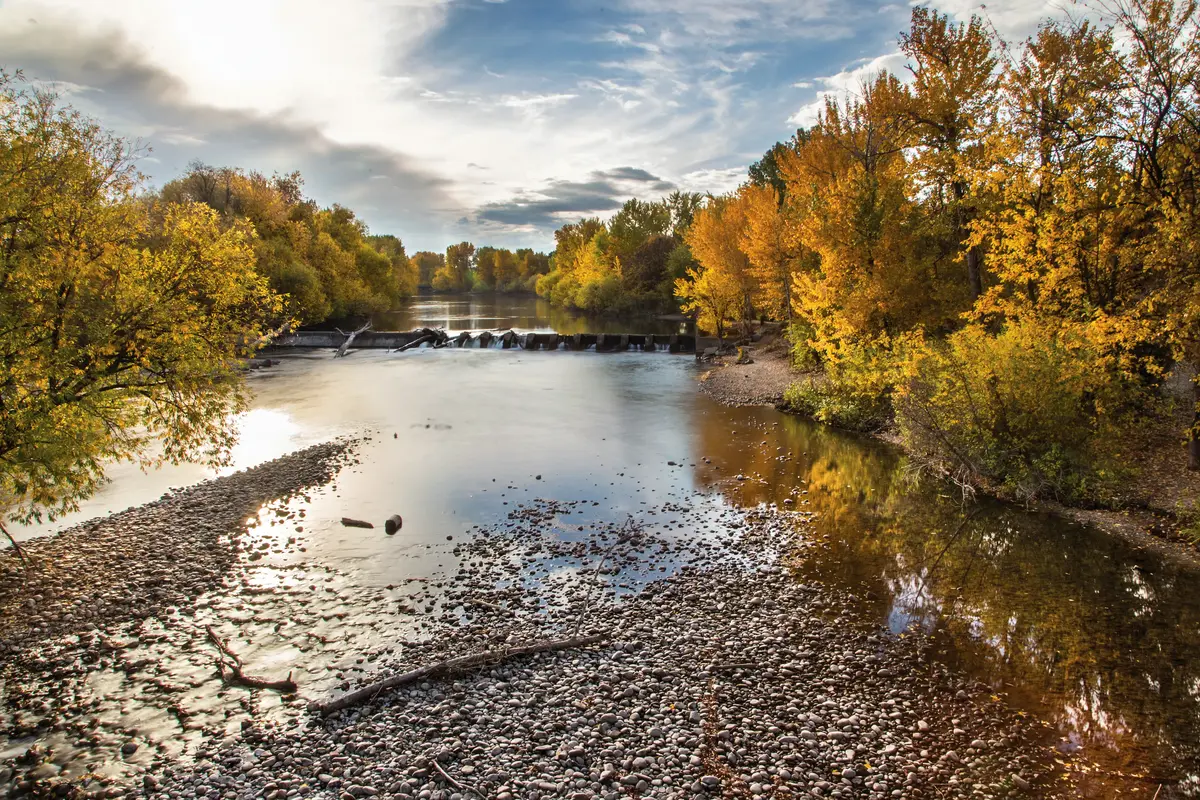
The first thing most California transplants notice after about three months: how quiet it is. Not rural quiet — Garden City has a Boise River Greenbelt that cuts through it, a growing strip of tasting rooms and studios along Chinden Boulevard, and Expo Idaho hosting the Western Idaho Fair and a steady calendar of events. But after Los Angeles, the Bay Area, or San Diego, the absence of ambient urban density is disorienting in a way people don't always anticipate.
The Chinden Corridor: Where Garden City Has Found Its Identity
Since the mid-2010s, the stretch of Chinden Boulevard running through Garden City has become the Treasure Valley's most concentrated zone of artisan production — craft distilleries, wine bars, galleries, and working studios shoulder to shoulder with light commercial. Bardenay Distilling on W. Chinden Blvd is a full-service restaurant and distillery that captures the strip's personality: you can sit down for dinner or walk out with a bottle of Idaho-made spirits. The Visual Arts Collective and Surel's Place anchor the cultural side; the Surel Mitchell Live-Work-Create District was designed specifically for working artists, which gives the neighborhood a texture most Treasure Valley suburbs entirely lack.
The Boise River Greenbelt is genuinely one of the best urban trail systems in the Mountain West. It runs for miles along the river and connects Garden City to downtown Boise, the Boise Whitewater Park, and neighborhoods to the east. Weekday mornings it belongs to commuting cyclists and dog walkers. Weekend afternoons it belongs to everyone. For Californians used to paying $3,500 a month to live near a beach path, having this out the back door at $474,000 feels like the deal was miscalculated in your favor.
What Surprises People at Six Months
August smoke. Wildfires across the broader Pacific Northwest push particulate matter into the Treasure Valley with enough regularity that locals have an air quality app on their phones the way Californians have a traffic app. It's not constant, and most years it's tolerable — but if you've been told Idaho has pristine air year-round, someone simplified that for you.
The other surprise: the Boise metro social scene scales smaller than expected. That's not a complaint for most transplants — it's often the point — but if you moved from a dense urban neighborhood with dozens of restaurant options within walking distance, Garden City itself won't replicate that. The answer is usually Boise, five minutes away, which has a genuine downtown food and arts scene. Garden City functions best as a base, not a destination in itself — unless the arts corridor and river access are exactly what you came for.
Where Families Actually Gather
The Greenbelt access points near Government Island are a consistent gathering spot for parents with kids on weekend mornings. The Expo Idaho grounds host community events beyond the annual Western Idaho Fair. For the school-age crowd, the Boise School District — which serves Garden City students — runs the extracurricular calendar; interscholastic sports fall under the Idaho High School Activities Association (IHSAA). The district's strong academic standing holds up against what most California coastal suburbs offer at significantly higher price points.
Traffic: The One Chokepoint Worth Naming
Chinden Boulevard at the merge toward State Street during the 5–6 p.m. outbound window is the one intersection that will teach you Garden City's limits. It's not Bay Area traffic — nothing here is — but it's slower than the five-minute-to-Boise claim implies on a weekday afternoon. The Greenbelt commute by bike to downtown Boise, on the other hand, is genuinely faster than driving during peak hours and takes roughly 20–25 minutes on a cruiser. Many transplants discover this in month two and don't go back.
Looking to buy in Garden City? Estimate your payment.
Enter your numbers to see an estimated monthly mortgage payment.
Estimate only. Excludes HOA fees and mortgage insurance. The interest rate above is a starting point, not a quoted rate — replace it with your own to see real numbers. Insurance is a flat placeholder, not a Garden City quote.
The Cultural and Lifestyle Adjustment: California vs. Garden City
Moving from California to Garden City isn't just a financial transaction — it's a shift in the texture of everyday life that takes longer to process than the spreadsheet suggests. Some of it is better than expected. Some of it is a genuine trade-off.
What You Gain
Space. Physical space in the home, in parking lots, on trails, and in the mental bandwidth that comes from shorter commutes and lower financial pressure. Californians who buy here after selling a coastal home often describe the first year as financially decompressive in a way that affects everything from work decisions to relationship dynamics. That's not hyperbole — it's what happens when a mortgage stops being the dominant fact of a household's financial life.
The arts scene along the Chinden Corridor punches above Garden City's weight class for a city of 13,000. The Visual Arts Collective holds regular exhibitions; Surel's Place brings resident artists from around the country. For buyers who specifically want walkable access to creative culture without paying Portland or Denver prices for it, this strip is a legitimate draw — not a consolation prize.
What You Give Up
Direct flights. Boise Airport (BOI) has improved its route network considerably, but if you flew nonstop to Europe, Asia, or the East Coast from San Francisco or Los Angeles on a regular basis, you'll notice the difference. Connections through Salt Lake City or Seattle become part of travel life.
Culinary density. Garden City's restaurant and bar scene is growing, but it's anchored to the Chinden strip. If you relied on a diverse, dense, neighborhood-by-neighborhood restaurant ecosystem — the kind that exists in San Francisco's Mission District or Los Angeles's Eastside — Boise's downtown is the closest substitute, and it's genuinely good, just smaller in scale.
Political and cultural environment. Idaho's political culture runs conservative. Garden City and Boise skew more moderate than the rural state average, but the legislative environment on issues from education funding to land use differs sharply from California. This matters practically: the regulatory and zoning approach to housing and business is different, which is partly why development here moves faster than you're probably used to.
The Move-Out Reality
People who leave Garden City — and some do — most often cite two reasons: the job market doesn't support their career track without remote work, or they miss urban density more than they expected to. Garden City's major employers include Expo Idaho, the Riverside Hotel, and the cluster of arts and hospitality businesses along Chinden. That's a real local economy for the right person, but it's not a tech corridor or a finance hub. If your income depends on being embedded in a sector cluster, the runway here is shorter. Remote work made this city's growth possible; if that changes, some of that growth unwinds.
Making the Move: Practical Steps for California Buyers
California buyers come in with one structural advantage that the local market notices: they often arrive with substantial equity and without a contingency sale chain. That changes what offers look like. It does not, however, replace the need to understand Garden City's specific dynamics before you put money down.
The Equity Deployment Question
The single most consequential decision California transplants make is what to do with the equity gap between what they sold and what they're buying. Deploying it all into the purchase keeps monthly costs low but concentrates Idaho real estate risk. Investing it separately means carrying a larger loan in a market that's appreciated significantly since 2019. There's no universal right answer — but it's worth modeling both scenarios before you close. The financing mechanics page has a framework for thinking through down payment sizing without prescribing a specific structure.
Establishing Idaho Residency
Idaho income tax is based on residency, not just where you earn. If you're carrying California-source income — consulting contracts, business income, capital gains from a sale — the day you establish Idaho domicile matters for which state claims that income. This is not something to sort out after the fact. Talk to a CPA who works across state lines before the move, not after the first Idaho return arrives.
Practically: Idaho residency requires an Idaho driver's license and vehicle registration (90 days for registration, sooner is better for license), plus documentation of domicile intent — a utility bill, a lease, or a deed in your name. California's tax authority has historically been aggressive about auditing high-income departures. Having a clean paper trail from day one protects you.
What Not to Do
Don't buy sight-unseen based on the price alone. The gap between Garden City's typical home value and what you sold in California is large enough that it can make any property look like a deal on a spreadsheet. Some properties along the Garden City Core near older industrial parcels carry noise and odor issues from adjacent land uses that don't show up in a Zillow listing. Walking the immediate surroundings at different times of day — including a weekday evening — is worth the extra trip.
Don't assume Chinden Boulevard is always navigable. If the property you're considering requires a daily left turn out of a driveway onto Chinden during the afternoon outbound hour, factor that friction into the daily routine before you commit. It's a small thing that becomes a non-small thing after 60 days.
Timing the Market
Ada County's pace of growth — more than 10,000 new residents in 2025 alone — means the window between listing and offer is often short when inventory is low. Spring listings move faster than fall ones. If you're relocating on a corporate timeline, budget for temporary housing rather than trying to time a purchase to a move-in date from 1,200 miles away. The rental market along the Chinden Corridor and near the Greenbelt provides reasonable short-term options while you orient yourself. For a full read on Garden City's neighborhood character before you narrow your search, the neighborhoods guide breaks down what each area actually delivers.
Local Expert Takeaway: Garden City rewards California buyers who come in knowing the crossover point: if your taxable household income runs well above $81,000, Idaho's flat 5.3% income tax saves real money against California's progressive brackets. The home price gap — Garden City's $474,544 typical value against California's $843,390 statewide median — is large enough that most sellers arrive with options, not just a down payment. What nobody tells you before you move: the Boise River Greenbelt running through the city is the daily quality-of-life asset that ends up mattering most, and the Chinden Corridor's arts and distillery strip — including Bardenay Distilling — gives the city a character that most Treasure Valley suburbs can't match. Spend a weekend here in October, when the smoke has cleared and the river trail is at its best, before you decide.
Quick Takeaways & FAQs
✅ Garden City's typical home value of $474,544 (ZHVI, April 2026) sits noticeably below the California statewide median, giving most California equity sellers a significant financial runway on arrival.
⚠️ Idaho's flat 5.3% income tax only beats California's progressive rate above approximately $81,000 in taxable income — lower earners should run the numbers before assuming automatic savings.
📍 Chinden Boulevard's afternoon outbound traffic toward State Street is the one real chokepoint in a city otherwise defined by its five-minute proximity to downtown Boise.
How much cheaper are homes in Garden City, Idaho compared to California?
Do I really save on taxes by moving from California to Idaho?
Is Garden City a good place to live if I'm working remotely from California?
What's the property tax situation in Garden City compared to California?
What should I know about daily life in Garden City that most relocation guides skip?
Moving to Idaho?
Tell us what you need help with and we'll connect you with local resources.
