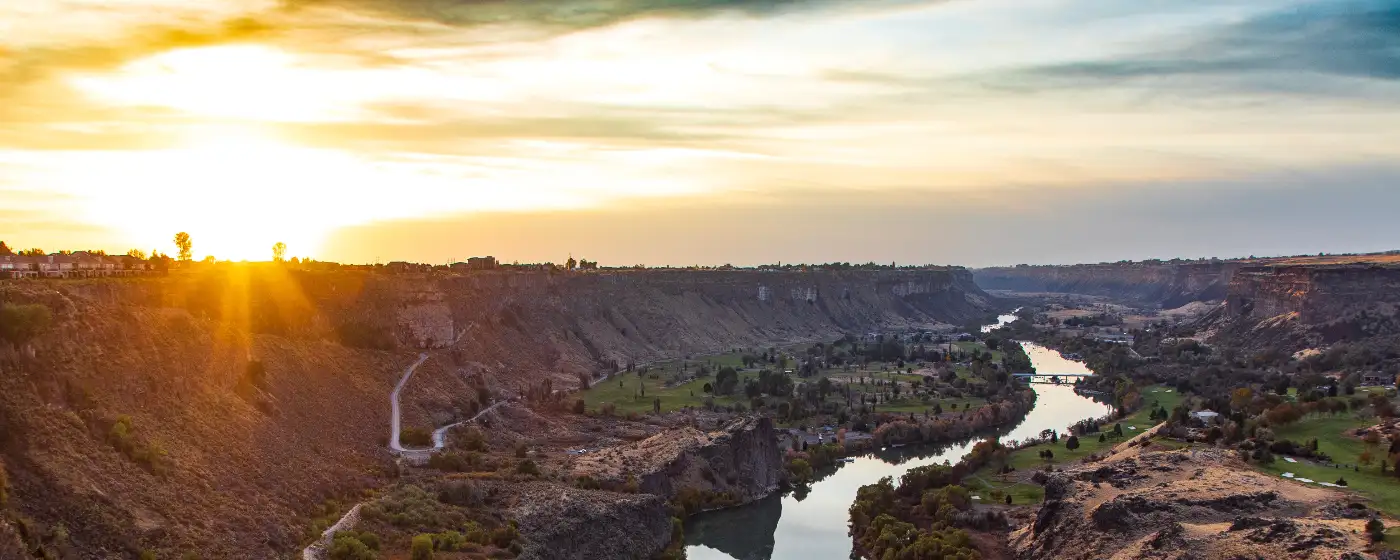
Maybe you've been priced out of Sacramento, or your Bay Area lease renewal arrived and you finally did the math. American Falls, Idaho sits at 4,410 feet on the Snake River in Power County's high desert — a town of roughly 5,011 people where the biggest local employer is a frozen-potato plant, the reservoir was built by moving an entire town out of its way in 1925, and the housing market operates in a completely different financial universe than the one you're leaving. That gap isn't a minor adjustment. It's the central fact of the move, and everything else flows from it.
The economic backbone here is agricultural and industrial: Lamb Weston's frozen-potato processing operation, Power County government, the American Falls School District, and the Bank of Commerce are the anchors. Pocatello — about 25 minutes west on I-86 — adds Idaho State University, a regional hospital, and full retail infrastructure to the picture, functioning as the city many American Falls residents treat as their second downtown. Who moves here? Mostly people who want land, quiet, and a mortgage payment that doesn't require two professional incomes to sustain — and who are willing to trade urban conveniences for that breathing room.
Idaho's composite cost-of-living index sits at 97.7 against a national average of 100. California's is 142.2, meaning the state you're leaving costs roughly 45% more on a broad basket-of-goods comparison. Day-to-day life in American Falls reflects that gap: the American Falls Reservoir draws boaters and anglers through the summer, American Falls City Park is where families with school-age children congregate on weekends, and Willow Bay Resort and Marina gives the waterfront a genuine recreational anchor. What you won't find is a walkable downtown coffee row or a weekend farmers' market circuit — and after six months, that absence is the thing Californians most consistently mention. See the full cost-of-living breakdown for utilities, groceries, and transportation figures.
Whether you're considering the move seriously or just stress-testing the numbers, the sections below walk through the home-price and tax comparison in detail, what your California equity actually buys here, the lifestyle adjustments that catch people off guard, and an honest read on the trade-offs before you make an offer.
The Home Price Gap: California vs. American Falls
The Zillow Home Value Index for American Falls in May 2026 is $320,000. California's statewide median runs approximately $776,000. That's not a rounding difference — it's a gap of roughly half a million dollars separating what the average home costs in each state.
For most Californians moving here, that gap converts into one of three outcomes: you arrive with substantial equity and buy outright or close to it, you significantly reduce your mortgage obligation and free up monthly cash flow, or you move up dramatically in square footage and land compared to what you could afford at home. All three are real outcomes people have experienced here.
What the Numbers Mean in Practice
The median of $320,000 (Zillow Home Value Index, May 2026) typically buys a well-maintained single-family home with a yard, a garage, and a street that feels nothing like a California subdivision. For more on how specific neighborhoods break down, see the neighborhoods guide.
What catches some California buyers off guard is that the market here is small and moves on its own rhythm. Inventory can be thin, and homes in good condition at the right price don't sit long. Coming from a high-volume California market, buyers sometimes underestimate how competitive a listing at $280,000 can get when there are only a handful of comparable options in town.
| Metric | American Falls, ID | California (Statewide) |
|---|---|---|
| Typical home value | $320,000 (ZHVI, May 2026) | ~$776,000 (median, Jan 2026) |
| Effective property tax rate | ~0.74% | ~0.70% (statewide avg) |
| State income tax | 5.3% flat (all income) | 1%–13.3% progressive (9 brackets) |
| State sales tax | 6% flat (~6.03% combined) | 7.25% base + local add-ons |
| Groceries taxed? | Yes (6%), with grocery tax credit | Generally exempt |
| State Disability Insurance (SDI) | None | 1.3% payroll deduction, no wage cap |
| Cost-of-living index | 97.7 (ID statewide) | 142.2 |
* ZHVI = Zillow Home Value Index.
Property tax rates look nearly identical on paper — Idaho's effective rate of approximately 0.74% sits just above California's roughly 0.70% statewide average. But that similarity evaporates when applied to actual home values: on a $320,000 home in American Falls versus a $776,000 home in California, the annual bill is dramatically lower here even at the marginally higher rate.
State Income Tax: Idaho's Flat Rate vs. California's Brackets
This is where the comparison gets genuinely interesting for anyone earning above a moderate income. Idaho moved to a flat 5.3% income tax rate on January 1, 2025 — enacted under HB 40, unchanged for 2026. Every dollar of taxable income gets taxed at that same rate, regardless of how much you earn.
California runs nine brackets from 1% at the bottom to 13.3% at the top, with an additional 1% Behavioral Health Services Tax on income above $1 million. If you've been in California's upper brackets — earning over $300,000, $500,000, or more — the state income tax reduction alone can offset the practical inconveniences of the move within the first year.
The Crossover Point
At approximately $81,000 of taxable income, Idaho's 5.3% flat rate becomes cheaper than what you'd pay under California's progressive structure. Below that threshold, some California filers actually pay less than 5.3% because of the lower brackets. Above it, the Idaho advantage widens meaningfully with each additional dollar earned. Your own situation depends on your filing status, deductions, and income mix — confirm the specifics with a CPA before making the move.
One deduction worth knowing: Idaho does not tax Social Security benefits, and the state allows an income-tax deduction for certain military retirement pay. These provisions don't apply to most working-age California transplants, but for anyone retiring here they change the math noticeably.
The Payroll Tax You Stop Paying
California's State Disability Insurance (SDI) tax runs at 1.3% in 2026 with no wage cap since 2024 — meaning a California employee earning $200,000 pays $2,600 annually in SDI alone. Idaho has no equivalent payroll deduction. That's not a fortune, but it's a line item that disappears from your pay stub on the day you become an Idaho resident.
The honest counterpoint: Idaho taxes groceries at the full 6% state rate, where California generally exempts them. Idaho does offer a grocery tax credit to qualifying residents, but it only partially offsets that cost, and the credit phases out at higher incomes. If your household spends heavily on food, run those numbers too — they won't erase the income-tax savings, but they're a real line item Californians rarely anticipate.
What Your California Equity Actually Buys Here
The clearest financial case for this move runs through equity. Californians who sell and arrive with substantial proceeds find that the price gap dramatically changes what financing looks like — the down payment covers a far greater share of the purchase, the monthly obligation shrinks considerably, and the pressure that defined homeownership in California largely lifts. That structural shift is what drives most of the in-migration to Eastern Idaho from California over the past several years.
Even buyers arriving without outsized equity find that the financing burden is a fraction of what it was in California. The monthly obligation on a $320,000 home at any reasonable down payment is structurally different from carrying a California mortgage — freeing up income for savings, for Pocatello's retail and medical infrastructure, or simply for a less pressured daily life. For buyers working through the financing details, the first-time homebuyer page covers loan programs and down-payment options relevant to Idaho purchases.
What You Give Up
American Falls is a small agricultural town, and the honest version of this guide says so plainly. There is no Trader Joe's — the nearest is in the Boise area, more than two hours west. There is no performing arts center, no independent bookstore cluster, no weekend restaurant rotation with a dozen options. Falls Grill on Harrison Street and The Dam Pizza Place on Pocatello Avenue are two of the confirmed sit-down options in town; Pocatello fills in the rest of the dining and entertainment gap for most residents.
The lifestyle adjustment that trips up California transplants most often isn't the cold winters or the high-desert summer heat — it's the quiet. After six months, people who moved expecting a slower pace sometimes find themselves driving to Pocatello just to feel like they're in a city. That drive is 25 minutes each way, which is manageable, but it's a real part of daily life here rather than an occasional errand.
What You Gain Beyond the Price Tag
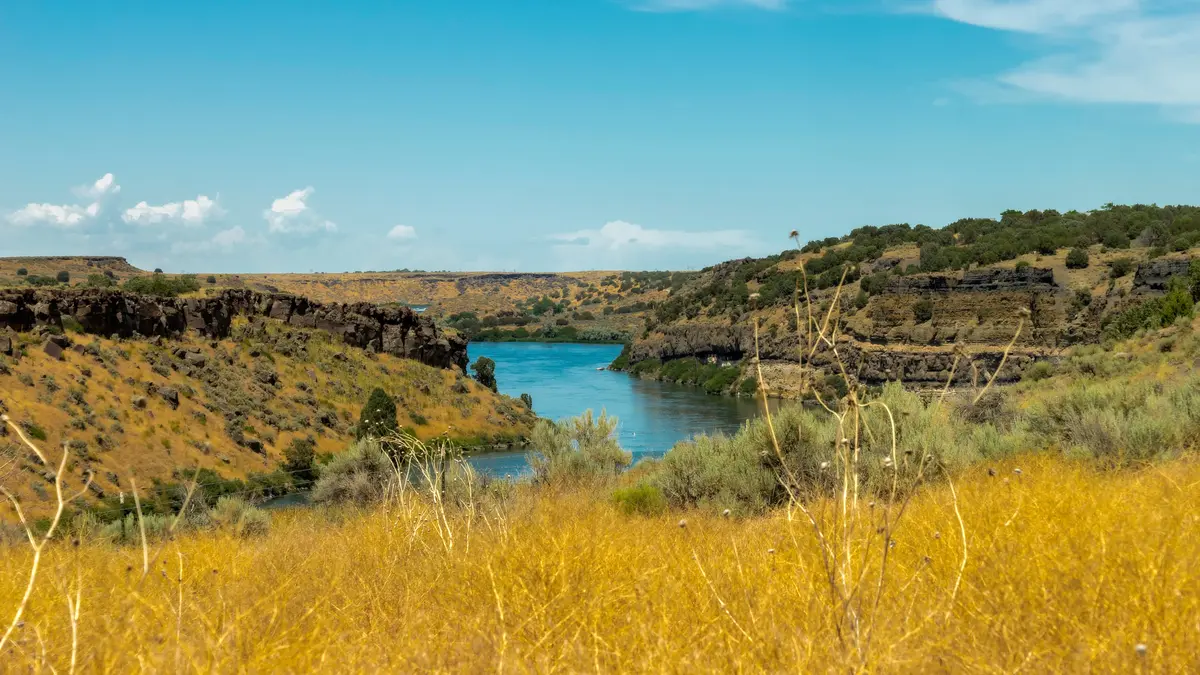
The American Falls Reservoir is genuinely exceptional — a working reservoir where boating, fishing, and camping on its shores define summer weekends for most families in town. Willow Bay Resort and Marina gives that recreation a physical hub. The Oregon Trail once crossed what is now the reservoir floor, which adds a layer of regional history that the Power County Museum documents well. For a detailed look at outdoor access, see the parks and recreation guide.
Looking to buy in American Falls? Estimate your payment.
Enter your numbers to see an estimated monthly mortgage payment.
Estimate only. Excludes HOA fees and mortgage insurance. The interest rate above is a starting point, not a quoted rate — replace it with your own to see real numbers. Insurance is a flat placeholder, not a American Falls quote.
Daily Life Adjustments Californians Should Expect
The I-86 interchange near Pocatello Avenue is the functional choke point of American Falls commuter life. If you're heading west toward Pocatello during the 7:15–7:45 a.m. window on a weekday, the merge onto I-86 can stack up — not a Bay Area backup, but real friction for a town this size. Heading out ten minutes earlier than feels necessary is the consistent workaround locals use. For the full employment and commute picture, see living in American Falls.
The school district is American Falls Joint School District 381, which serves this community as a standalone district in a county-seat town — meaning sports, theater, and activities don't have the breadth of a larger district, but the student-to-teacher ratio tends to be tighter than what families leaving large California suburban districts are used to. For ratings and specific school information, see the schools guide.
Where People Actually Gather
American Falls City Park, which runs along the Snake River near the dam, is where families with school-age children collect on summer evenings. It's the kind of place where you learn your neighbors' names within the first few weeks of arriving — an experience that's genuinely different from moving into a California suburb of 80,000 people. The Friday social scene is thin by California standards; most residents either host at home or make the run to Pocatello for dinner out.
What Locals Know About Winter
Eastern Idaho winters are serious. The elevation sits at 4,410 feet, and the Snake River plain channels wind in a way that makes January feel colder than the thermometer suggests. California transplants who've been to Tahoe once or twice sometimes underestimate this. Heating costs are real, and roads in and around Power County can close temporarily during heavy snow events. Budget for that in both dollars and time.
Crime in American Falls runs at levels that many families moving from California's larger metro areas would consider an improvement — for the specific figures, see the safety guide. The town-sized reality is that most people know enough of their neighbors to notice when something is off, which is its own form of community safety net.
The Honest Verdict: Who This Move Works For
The case for moving from California to American Falls is strongest if you're working remotely or your industry has a presence in the Pocatello corridor, you're arriving with equity that dramatically reduces your financing burden, and you've genuinely thought through what you're trading away — not just what you're gaining. The people who thrive here are the ones who moved for the land, the quiet, and the lower cost structure, not the ones who expected a California lifestyle at Idaho prices.
The move tends to disappoint buyers who are primarily motivated by escaping California but haven't reckoned with what small-town agricultural Idaho actually looks like day to day. If you need walkable streets, a restaurant row within a short walk, or cultural amenities you can access without a 25-minute drive, American Falls will frustrate you. That's not a knock on the town — it's just an honest read on fit.
Who Leaves — and Why
The people who move out of American Falls after a year or two most often cite the same handful of reasons: limited local employment options beyond agriculture and government, the distance from specialized medical care, and the social isolation that can set in when the novelty of the reservoir and the quiet wears off. Young professionals without remote-work flexibility find the job market genuinely narrow. That's worth weighing seriously if your employment situation could change.
The Tax Argument, Summarized
If you earn above approximately $81,000 in taxable income, Idaho's 5.3% flat rate is cheaper than California's progressive brackets, and the advantage grows from there. You lose California's SDI deduction the day you move. You gain a property tax bill calibrated to a home worth a fraction of what California's median commands. On balance, the tax picture strongly favors Idaho for moderate-to-high earners — but grocery tax is a real addition to your budget that most Californians don't anticipate, and the grocery credit only goes so far.
American Falls is a specific kind of Idaho: not the ski-resort Idaho of Sun Valley, not the tech-adjacent Idaho of Boise's suburbs. It's county-seat, Snake River plain, frozen-potato-plant Idaho — and that specificity is exactly what makes it work for the people it works for.
Local Expert Takeaway: American Falls is not a soft landing from California — it's a real relocation into a small Eastern Idaho agricultural town where Lamb Weston is the largest private employer, Falls Grill on Harrison Street and The Dam Pizza Place on Pocatello Avenue cover most of your local dining options, and the American Falls Reservoir is genuinely the recreational centerpiece of community life. The tax and price math is compelling for anyone arriving with California equity or a high income. The lifestyle math requires honesty about what you need to feel settled. Run both sets of numbers before you make an offer.
Quick Takeaways & FAQs
✅ The typical home value of $320,000 (Zillow Home Value Index, May 2026) means California equity can eliminate or dramatically reduce a mortgage here — a structural financial shift, not just a lifestyle choice.
⚠️ American Falls offers almost no walkable commercial district and limited local employment outside agriculture and government — Pocatello's 25-minute commute isn't optional for most residents, it's built into the daily routine.
📍 Idaho taxes groceries at the full 6% state rate — unlike California, which generally exempts them — so the grocery tax credit and that line item in your budget both need to be factored into any California-to-American Falls cost comparison.
How much cheaper are homes in American Falls compared to California?
Does Idaho have lower income taxes than California?
Are property taxes higher or lower in American Falls than in California?
What do Californians most often say they didn't expect after moving to American Falls?
Is Idaho sales tax higher or lower than California's?
Moving to Idaho?
Tell us what you need help with and we'll connect you with local resources.
