
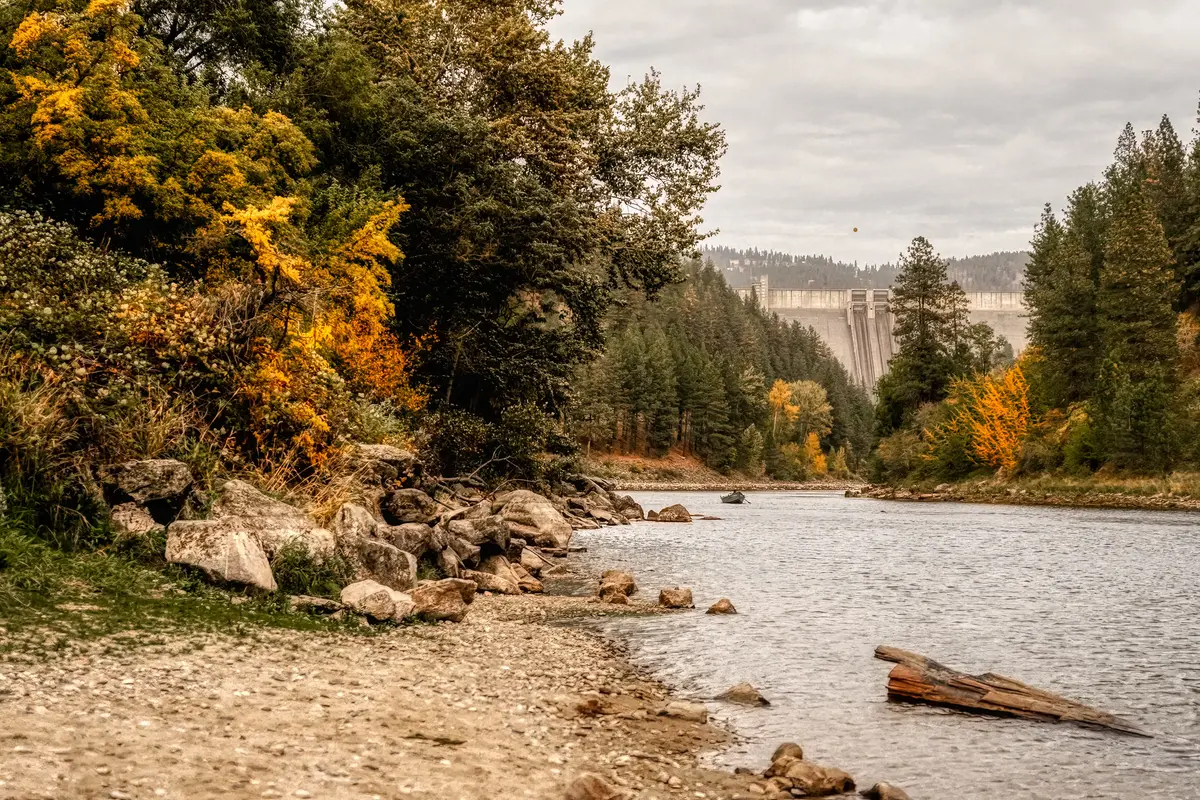
Most Californians who end up in Orofino weren't looking for Orofino specifically. They were looking for a way out — out of six-figure property taxes on a modest house, out of a commute that devoured two hours a day, out of a cost structure that made saving feel impossible. Someone mentioned northern Idaho. They looked at the map, saw the Clearwater River snaking through a valley flanked by dense ponderosa forest, and started doing math. The math looked very different from what they left behind. Orofino sits along U.S. Highway 12 in Clearwater County, about 50 minutes east of Lewiston and roughly 45 miles from the Washington state border. It is small — around 3,260 people — and it operates at a pace that will feel either liberating or disorienting depending on what you're used to.
The economic foundation here is almost entirely public-sector: Idaho State Hospital North, the Idaho Correctional Institution-Orofino, Clearwater National Forest offices, and the Orofino Joint School District #171 are the anchors. If you're relocating with remote work income or a pension, you're well-positioned. If you're expecting to replicate a Bay Area or Los Angeles salary by finding local employment, the adjustment will be significant — local wages and employment depth are a fraction of what most California metros offer. What the town offers instead is a cost structure so far below what most Californians pay that the income gap shrinks considerably in real purchasing power.
Orofino's overall cost of living scores 85.6 on BestPlaces — meaning total day-to-day costs run approximately 14.4% below the U.S. national average. Food costs alone run roughly 17.3% below the national average. The median home sale price as of May 2026 was $255,000 — a figure so far below most California markets that it requires a moment to absorb. You can find more on Orofino's full cost breakdown, but the short version is that a household that struggled to tread water in a California suburb can often build genuine financial margin here.
Whether you're seriously researching this move or just starting to ask questions, the sections below break down the tax comparison with California, what home prices actually look like, what daily life here requires, what California transplants consistently get wrong, and what this town genuinely offers — and doesn't.
The Tax Picture: Idaho vs. California Side by Side
The state income tax difference is real and it's large. California's top marginal rate hits 13.3% — that's 12.3% plus a 1% surtax on income over $1 million. Idaho moved to a flat rate of 5.3%, retroactive to January 1, 2025, under legislation signed by Governor Brad Little. For a dual-income household earning $160,000 combined, the swing in state income tax alone can amount to thousands of dollars annually staying in your pocket rather than going to Sacramento.
| Tax Category | California | Idaho (Orofino) |
|---|---|---|
| State Income Tax | Up to 13.3% (marginal) | 5.3% flat rate |
| Effective Property Tax Rate | ~0.70% (statewide avg.) | 0.70% |
| Statewide Sales Tax | 7.25% base (local add-ons apply) | 6.0% (avg. combined 6.03%) |
| Estate / Inheritance Tax | None (state-level) | None |
| Grocery Tax Credit | None | $155/person/year; up to $250 more with receipts |
| Parental Choice Tax Credit | None | Up to $5,000/student; $7,500 for students with disabilities |
The property tax rate comparison deserves a careful read. Both states sit near 0.70% effective rates — but that figure behaves very differently depending on your home value. California's Proposition 13 caps assessed value increases, which helps long-term owners. When you sell and buy in Orofino at $255,000, you're paying 0.70% on $255,000. That is a genuinely low annual bill.
Sales tax in Idaho runs lower than California's base rate, and Idaho softens the blow further with a grocery tax credit of $155 per person per year — raised from $120 in 2025 — with an additional credit of up to $250 available if you submit grocery receipts. Families of four claim this across four household members. It doesn't fully eliminate the tax on food, but it meaningfully offsets it.
Idaho also has no estate or inheritance tax, which matters for families transferring property across generations. And the Parental Choice Tax Credit — a refundable credit of up to $5,000 per student for private school or homeschool expenses, upheld by the Idaho Supreme Court in early 2026 — is a meaningful add for families with school-age children who use alternatives to public education.
What the Tax Shift Means in Practice
The income tax reduction is the most immediately felt change for remote workers and W-2 earners. If you're bringing California income into Idaho, switching from California's progressive brackets to Idaho's 5.3% flat rate typically produces a noticeable annual savings. That savings compounds over time — and when paired with lower housing costs, it changes the math on retirement timelines, savings rates, and monthly cash flow in ways that take most newcomers by surprise.
Home Prices: What $255,000 Gets You Here
The median home sale price in Orofino was $255,000 as of May 2026. For context, that number sits dramatically below the median in most California coastal and inland markets. You are not trading up in square footage — you are often trading up in ownership itself, moving from renting in California to owning outright in Idaho.
What that price range buys in Orofino: single-family homes with yards, proximity to the Clearwater River, and in many cases mountain or forest views. These are not condo conversions or fixer-uppers in industrial zones. They are houses on real lots, in a town where your nearest neighbor isn't eight feet away through a shared wall.
What California Buyers Should Expect in the Process
Inventory is thin. Orofino's market is small, and desirable homes — especially anything along Riverside or with clear sight lines to the hills — can move quickly. Unlike competitive California markets where offers pile up within 48 hours, Orofino's pace is more deliberate, but that doesn't mean you can take weeks to decide on a home you want.
Financing a home at this price point in Idaho feels genuinely different from California. You're likely looking at a purchase where standard down payment strategies go further, and where monthly ownership costs leave real breathing room versus what you were paying in rent or a mortgage in California. The first-time homebuyer page covers loan programs and down payment options in detail.
One honest caution: don't assume every property at this price is move-in ready. Some of Orofino's lower-priced inventory reflects deferred maintenance or dated interiors. Budget for a thorough inspection. The savings on the purchase price create room to address those issues — but you should know they exist before making an offer. For a closer look at how neighborhoods break down, the neighborhoods guide covers the key distinctions across areas like Downtown Orofino, Upper Orofino, and the College Avenue corridor.

Daily Life Differences a Californian Won't See Coming
The first thing most California transplants comment on — usually around month two — is the silence. Not the absence of traffic noise specifically, but the absence of urgency. Orofino moves at a pace that feels alien if you've spent years in a metro area. That's not a complaint from most people who stay. But it does require an adjustment period.
Grocery and Retail Reality
There is no Trader Joe's. There is no Whole Foods. The closest Costco is in Lewiston, 50 minutes away on Highway 12, and that drive becomes part of your monthly rhythm. Orofino's local dining scene is real but genuinely small — House of JuJu on Johnson Ave handles burgers and American comfort food, O-Town Mugs and Grubs on Johnson Ave covers the sports bar crowd, Dining on the Edge on Main St is the spot for a proper sit-down dinner, and the Ponderosa Restaurant and Brass Rail Lounge rounds out the family dining options. That is approximately the full rotation. California transplants who eat out three or four times a week will find themselves cooking more, which is not a bad outcome but is a real one.
The Highway 12 Factor
Winter on Highway 12 is not an abstraction. North Idaho winters run substantively colder and snowier than essentially every California climate outside the Sierras. The road between Orofino and Lewiston follows the Clearwater River canyon, and when it ices over in January, the drive that takes 50 minutes in August can take considerably longer — or be inadvisable until IDOT has cleared it. Budget for snow tires, a quality set of chains as backup, and heating costs that will surprise you your first winter.
What People Don't Expect About Community
Orofino City Park along the Clearwater River is where the town gathers on summer evenings — youth games, families walking the trail, informal social life happening without any particular occasion. The Clearwater Historical Museum and Bicentennial Historical Park are genuine community anchors, not tourist traps. People here know each other across generational lines in a way that most California suburbs don't produce. That integration takes time to access, and some California transplants find the first year feels socially thin. Push through it. Join something. The community rewards persistence.
Looking to buy in Orofino? Estimate your payment.
Enter your numbers to see an estimated monthly mortgage payment.
Estimate only. Excludes HOA fees and mortgage insurance. The interest rate above is a starting point, not a quoted rate — replace it with your own to see real numbers. Insurance is a flat placeholder, not a Orofino quote.
Why People Leave Orofino — and Who Tends to Stay
The honest version of this guide includes the reasons people leave. The job market is the most common one. Orofino's employment base is anchored in public-sector positions — corrections, state mental health, education, federal forest work. Private-sector professional opportunities are limited. If your remote work situation changes or your employer recalls you to an office, there is no local tech sector, no regional finance hub, no fallback. Lewiston at 50 minutes is the nearest city with meaningful employment depth, and that commute adds up.
Isolation is the second reason. Orofino is a genuinely small town — 3,260 people — and the nearest metro services, specialty retail, and cultural events are in Lewiston or further. Families with teenagers sometimes find the options for their kids narrow in ways that become friction points by high school. Orofino Joint School District #171 serves the area; for detail on programs and performance, the schools page covers it directly.
Who Tends to Stay
Remote workers with stable income who moved intentionally — not on impulse — tend to stay. Retirees and near-retirees who prioritized low costs, outdoor access, and a slower pace over urban amenities tend to stay. People with family connections in the region stay. People who moved here because they genuinely wanted to live near the Clearwater River and Dworshak Dam, who wanted to hunt and fish and hike the Clearwater National Forest as a regular practice rather than an annual vacation — those people stay and tend to become the most vocal advocates for the town.
The people who leave are usually the ones who moved for the home price and assumed everything else would sort itself out. The price is real. But so is the isolation, the winters, and the limited local economy. Going in with eyes open on both sides is what separates a good move from a costly mistake.
For a fuller picture of who Orofino suits at different life stages, the Living in Orofino guide covers employer landscape, lifestyle fit, and community character in more depth.
Making the Move: Practical Steps for California Relocators
Establish Idaho residency promptly and correctly. This matters more than most California transplants expect. Idaho residency requires a valid Idaho driver's license or ID, vehicle registration in Idaho, and voter registration if applicable. California monitors high-income individuals who leave the state, and you will want to document your move date, your physical presence in Idaho, and your separation from California-based income sources carefully. This is not alarmist — it is a known friction point for California-to-Idaho moves at higher income levels, and a CPA familiar with both states is worth the fee.
Transferring Vehicles and Licenses
Idaho gives new residents 90 days to transfer a driver's license and register vehicles. The DMV in Orofino handles this, though for certain transactions you may need to go to Lewiston. Factor in the Idaho vehicle inspection requirement if your vehicle has California emissions equipment — Idaho's standards differ, and most vehicles transfer without issue, but it's worth confirming before you assume.
The Timeline Most People Get Wrong
Most California transplants underestimate how long it takes to feel settled in Orofino. The first six months often feel like an extended camping trip — novel, beautiful, occasionally disorienting. By month nine or ten, you've made a grocery run to Lewiston fifteen times, you've lived through one heating season, and you have a clearer sense of whether this is actually your life or an experiment. The people who plan for that adjustment window — who don't make major financial decisions in the first six months based on either euphoria or doubt — make the transition far more cleanly.
On safety: Orofino's crime figures are worth knowing before you move. The safety page covers violent and property crime data in full context. And for the outdoor access that draws most people here in the first place — the Clearwater River corridor, Dworshak Reservoir, Canoe Camp, and the Lewis and Clark history embedded in this landscape — the parks and recreation page is where to go deep.

Local Expert Takeaway: The financial case for moving to Orofino from California is genuine — a $255,000 median home price, Idaho's 5.3% flat income tax versus California's rates that climb to 13.3%, and a cost of living running roughly 14% below the national average add up to real, compounding savings. The catch is that Orofino is a small town in a river canyon in North Idaho, not a suburb with California amenities at Idaho prices. Dinner out means House of JuJu or O-Town Mugs and Grubs on Johnson Ave or Dining on the Edge on Main St — not a rotating list of twenty options. Costco is a planned trip to Lewiston. January on Highway 12 requires preparation. Move here because you want this specific life, not because the spreadsheet looked good. Those two motivations produce very different outcomes by year two.
Quick Takeaways & FAQs
✅ Idaho's flat 5.3% income tax rate is among the most significant financial advantages for California earners moving to Orofino — the contrast with California's top marginal rate of 13.3% is substantial and immediate.
⚠️ Orofino's local job market is narrow and public-sector dominated — remote workers are well-positioned, but anyone expecting to replicate a private-sector California income locally will face a difficult adjustment.
📍 Highway 12 between Orofino and Lewiston follows the Clearwater River canyon and can be genuinely treacherous in winter; snow tires and a flexible schedule for January and February are non-negotiable, not optional.
How much cheaper are homes in Orofino compared to California?
Will California try to tax me after I move to Idaho?
What is Idaho's income tax rate compared to California's?
Is it hard to find work in Orofino as a California transplant?
What's the biggest surprise for Californians after moving to Orofino?
Moving to Idaho?
Tell us what you need help with and we'll connect you with local resources.
