
Most Californians who move to Chattanooga say the same thing around month three: they keep waiting for the catch. The home they bought for less than a third of what a comparable place would cost in their old zip code. The paycheck that lands without a state income tax line. The parking that is free and the traffic that is, by California standards, barely a concept. The catch, if there is one, is the weather — but more on that below. Chattanooga is a city of 194,144 sitting at the intersection of I-24 and I-75 in the southeastern corner of Tennessee, cupped by the Tennessee River on one side and Lookout Mountain on another. It is the 4th-largest incorporated city in Tennessee, and it has spent the last decade building enough of a real downtown — the Northshore, the Southside, the Tennessee Riverwalk — that the comparison with a mid-sized California city is no longer a stretch.
The employer base is more diversified than most cities this size can claim. Volkswagen runs a full manufacturing campus here. BlueCross BlueShield of Tennessee and Unum Group both anchor significant office operations. Amazon operates logistics facilities. That mix — automotive, insurance, healthcare administration, e-commerce — means the local economy doesn't live or die on any single sector. The Hamilton County school district, with 44,855 students enrolled in 2024-25, holds a B- rating, according to Niche, which is a useful honest baseline: not the top-tier district you'd find in some California suburbs, but a real system covering a wide range. The full picture on schools is at the Chattanooga schools page.
The headline number for California transplants is the typical home price: $319,185 as of August 2026 (Zillow Home Value Index). California's statewide typical home value of $764,158 gives you the gap in plain arithmetic. Chattanooga's overall cost of living runs noticeably below the national average, with housing the biggest driver of that gap. Rent runs well below what most Californians pay — see the full breakdown at the cost-of-living page. Add the fact that Tennessee levies no state income tax of any kind — wages, salaries, pensions, retirement withdrawals, all exempt — and the monthly financial picture shifts considerably from day one.
Whether you are being relocated by an employer, pricing yourself out of the California market, or deliberately trading coastal density for river-valley elbow room, the sections below break down what the California-to-Chattanooga move actually looks like on paper and in practice: taxes, housing, the honest trade-offs, the neighborhoods, what to expect from the climate, and what locals know that the spreadsheets don't show.
The Tax Shift: What Tennessee Actually Does to Your Take-Home Pay
The single largest financial change for most California transplants is not the home price — it is the tax line that disappears from their paycheck. Tennessee levies no state individual income tax of any kind. Wages, salaries, retirement distributions, Social Security, IRA and 401(k) withdrawals — all exempt at the state level. California's top state income tax rate of 13.3% applies only to the highest earners, but even middle-bracket Californians are giving up 6–9% of income to Sacramento. That stops entirely on the day you establish Tennessee residency.
The trade comes on the sales tax side. Tennessee's combined state and local sales tax averages approximately 9.61% — among the highest in the country. California's statewide base sales tax rate of 7.25% is the floor before local add-ons, and many California cities push their combined rate above 10%, so depending on where exactly you lived, the sales tax difference may be smaller than the headline suggests. What you are actually trading is a significant income-tax burden for a slightly elevated consumption tax. For most buyers, especially those with retirement income or above-average wages, that is a strongly favorable trade.
Property taxes run well below what California homeowners typically pay. Chattanooga's effective property tax rate is 0.56%. California's effective property tax rate of 0.71% is already low by national standards — Proposition 13 keeps assessed values anchored — but Tennessee's rate is lower still, and on a home priced at a fraction of a California equivalent, the annual bill is a fraction of a fraction.
| Tax Category | California | Tennessee / Chattanooga |
|---|---|---|
| State income tax (top rate) | 13.3% (highest in the nation) | None (fully eliminated) |
| Effective property tax rate | 0.71% | 0.56% |
| State base sales tax rate | 7.25% before local add-ons | 7% state + local avg.; combined ~9.61% |
| Tax on retirement income | Taxed as ordinary income | Fully exempt at state level |
| Hall Tax (dividends/interest) | Taxed as ordinary income | Phased out fully by 2021 |
One thing Californians often overlook: Tennessee's higher sales tax hits groceries, too. Food and food ingredients are taxed at a reduced state rate, but they are not exempt the way they are in some states. Budget for that on your first run to the store.
Home Prices and What Your California Equity Actually Buys Here
The typical home price in Chattanooga was $319,185 as of August 2026, per the Zillow Home Value Index. California's statewide typical home value of $764,158 is a useful baseline for the comparison — and that is the statewide figure, not a coastal-metro number. If you are arriving from the Bay Area, Los Angeles, or San Diego, the gap between what you are selling and what you are buying is likely to be substantial.
What that spread means in practice: California transplants frequently arrive with enough equity to buy outright, or to carry a very small mortgage. Many come with enough left over to furnish, renovate, or invest. That is a different relationship with housing than most Chattanooga residents have — the median household income here is $61,028, and at current prices, that income level does not comfortably reach the typical home without a sizable down payment. California equity changes that calculation entirely.
What the Neighborhoods Offer
Chattanooga's geography means the type of home varies as much as the price tier. North Shore and the Southside are the most urban in character — walkable streets, restaurants within a few blocks, older housing stock with character renovations. East Brainerd runs toward suburban ranch homes and newer construction with more square footage per dollar. St. Elmo, at the base of Lookout Mountain, has a distinct neighborhood identity and a mix of cottage-scale homes and larger lots. Lookout Valley sits below the mountain on the western approach and offers the most accessible entry point into the market. Missionary Ridge carries ridge-top views and a quieter residential feel. A full neighborhood breakdown lives at the Chattanooga neighborhoods page.
The Honest Entry-Level Picture
Chattanooga is not a market where equity from a California sale always translates to a luxury purchase. The upper end of the Chattanooga market is genuine but not deep — inventory at the top tier moves slowly and the pool of comparable sales is thin. Where California buyers more often land is in the mid-range, buying a home that by California standards would be considered entry-level pricing but by Chattanooga standards is a comfortable, well-maintained family house. That adjustment in expectation — buying a real home rather than a starter — is the part most California transplants say felt the strangest, and then the best.
Routine care costs run noticeably below California levels, and transportation costs overall run roughly 11% below the national average, which adds up over a year of errands and commutes.

The Climate Adjustment: What Californians Are Not Ready For
If there is one thing that catches California transplants off guard, it is the humidity. Not the heat — the heat is manageable. July highs average around 88°F, which is warm but not extreme by Southern standards. It is the combination: 88°F with 75–80% relative humidity is a fundamentally different physical experience than 95°F and dry in the Central Valley, or 80°F and coastal-breezy in the Bay Area. Your first Chattanooga July will feel like standing inside a warm wet towel.
Precipitation is the second adjustment. Chattanooga averages roughly 50–58 inches of rain annually — well above the U.S. average of 38 inches, and an order of magnitude more than coastal Southern California. There is no dry season. Rain comes in every month. Californians who moved through years of drought will find this jarring in the first year, and then usually appreciate it when they see how green everything stays. The city logs 207 sunny days a year, which is below what most of California's major metros advertise but still more sunshine than the Pacific Northwest.
What the Seasons Actually Feel Like
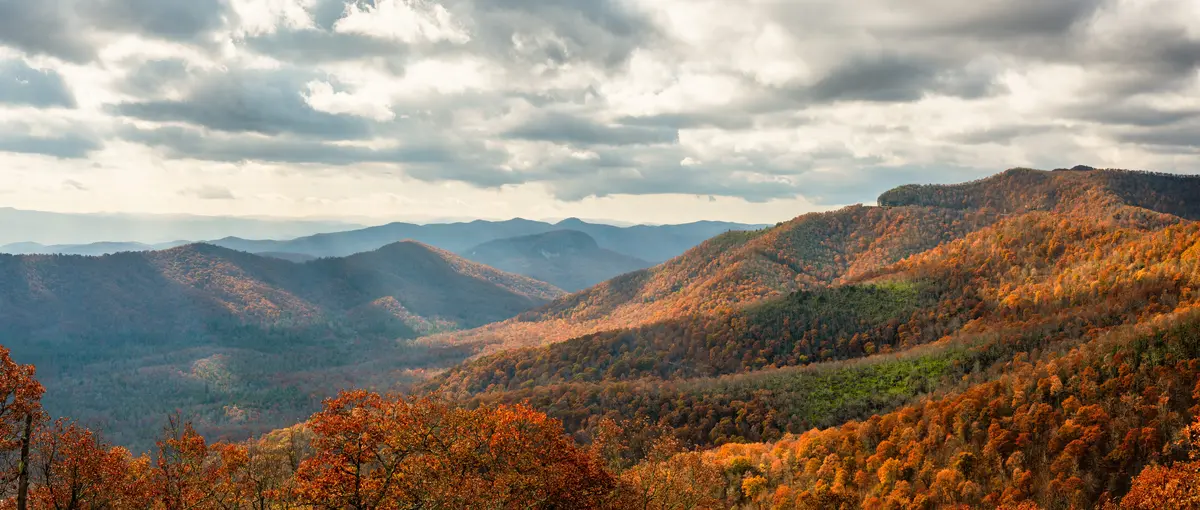
Spring in Chattanooga is genuinely beautiful — dogwoods and redbuds along the river greenway, temperatures in the 60s and 70s, manageable humidity. Fall is the season most transplants end up citing as their favorite: mild, dry by comparison, color on the ridge lines. Winters are mild enough that snow is an event rather than a season, though ice storms happen and the city, like most Southern cities, does not have the infrastructure to handle them gracefully. Expect a few days a year where everything shuts down over an inch of ice.
The practical upside of four real seasons: outdoor recreation changes character throughout the year in a way it simply doesn't in most of California. Lookout Mountain, the Tennessee Riverwalk, and Raccoon Mountain Caverns all shift with the seasons in ways that keep the outdoors genuinely engaging year-round. Californians who were outdoors people at home tend to stay outdoors people here — just with better rain gear.
Looking to buy in Chattanooga? Estimate your payment.
Enter your numbers to see an estimated monthly mortgage payment.
Estimate only. Excludes HOA fees and mortgage insurance. The interest rate above is a starting point, not a quoted rate — replace it with your own to see real numbers. Insurance is a flat placeholder, not a Chattanooga quote.
Beyond the Monthly Mortgage Payment — What to Factor In
- The property tax rate above — The 0.56% used in the estimate is the median effective rate — tax actually paid as a share of market value — published by Ownwell, 2026. Half of local homes pay more and half pay less: your own bill depends on that property's assessed value and any exemptions it qualifies for, which can differ a lot from its market price. Confirm with the Hamilton County assessor before you budget.
- Total cost of ownership — Your monthly mortgage payment is just the baseline. Depending on the specific city, county, and service district, homeownership costs also include local utility fees, municipal surcharges, and special assessments (such as water, sewer, storm drainage, or local energy taxes) that vary by location.
- Independent due diligence — Because these recurring local costs and municipal fees change depending on the exact property address, buyers must research them independently during their transaction process.
Tax laws, local municipal fees, and utility costs change frequently and individual situations vary. This page is general information, not tax or legal advice — always consult a qualified tax professional, CPA, or local municipal offices for personalized guidance.
Jobs, Infrastructure, and the California Transplant's Professional Calculus
Chattanooga's employer base is more deliberately diversified than most cities its size. Volkswagen's manufacturing campus, BlueCross BlueShield of Tennessee, Unum Group, Amazon, and a regional health system anchor the economy across automotive, insurance, logistics, and healthcare administration. No single employer dominates the way a flagship tech campus or government contractor anchors some peer cities. That breadth is a stabilizing force — but it also means Chattanooga is not a tech hub by California standards, and transplants who made their living in that world are often working remotely rather than finding a local equivalent.
Remote work is, genuinely, a big part of why many Californians choose Chattanooga specifically. EPB, the municipal utility, operates a 100% fiber-optic network serving more than 170,000 homes and businesses, offering symmetrical speeds from 300 Mbps up to 25 Gbps across a 600-square-mile footprint. Chattanooga earned the nickname "Gig City" from this infrastructure, and it is not marketing — the speeds are real and the network is city-wide. For remote workers dependent on video calls, large file transfers, or distributed dev work, this is a material quality-of-life factor that few cities at this price point can match.
The Job Market, Honestly
The Chattanooga MSA had a relatively slow year for job growth in 2025 — manufacturing shed positions while education and healthcare services added back roughly the same number. Fourteen Chattanooga-area companies appeared on the 2025 Inc. 5000 list, with a collective three-year median revenue growth of 323%, which signals genuine small-business and startup activity beneath the headline employers.
For California transplants starting or relocating a business, the Hamilton County business incubator is the largest in Tennessee and the third largest in the country, offering approximately 127,000 square feet of office and manufacturing space. Battery-technology manufacturer Novonix also secured approval in 2025 to build a second manufacturing plant at Enterprise South Industrial Park, adding up to 500 positions — a signal of continued advanced-manufacturing investment even in a slower cycle.
Chattanooga Metropolitan Airport serves as a genuine regional hub, with nonstop service to a meaningful range of destinations across multiple carriers. For transplants who still have family or clients on the West Coast, the airport connection matters, and CHA has been among the faster-growing small hub airports in the country by seat capacity in recent years. The airport sits about 11 miles from the city center.
Weekends, Local Life, and What Actually Keeps Californians Here
Most California transplants expect to miss the food scene most. They usually don't. Chattanooga's restaurant and coffee culture has enough range to surprise people who assumed a mid-sized Southern city meant a chain-heavy landscape. Boathouse Rotisserie & Raw Bar draws the river crowd for seafood; State of Confusion and Feed Table and Tavern both run the kind of thoughtful, ingredient-forward menus that Californians recognize; STIR and Scotties on The River fill out the local dining scene at different price points and atmospheres. None of them are trying to be California, which is part of the appeal.
For coffee, Rembrandt's Coffee House has been part of the Northshore for years; Niedlov's Cafe & Bakery brings a proper bakery-café operation that stands on its own; Milk & Honey, Stone Cup Cafe, and Velo Coffee Roasters round out a scene that is genuinely independent rather than chain-dependent. Pick up a bag at the Chattanooga Market or the Main Street Farmers Market on a warm weekend and you get a quick read on how the city gathers — it is a real community market, not a tourist attraction.
The Outdoors That Keeps People Here
Lookout Mountain is the most visible landmark — Rock City and Ruby Falls draw visitors from across the region, but residents use the mountain as a genuine backdrop for hiking and ridge-line views year-round. Raccoon Mountain Caverns and the Reflection Riding Arboretum & Nature Center both offer the kind of natural education that families with kids return to repeatedly. The Tennessee Riverwalk runs along the waterfront and functions as the city's de facto public commons — the place where you are most likely to run into your neighbors on a weekday morning or a Saturday afternoon.
The Walnut Street Walking Bridge connects the downtown side of the river to the Northshore on foot, which is the kind of infrastructure detail that sounds minor until you realize it makes two distinct parts of the city feel like one. The Tennessee Aquarium and the Hunter Museum of American Art both sit within a few blocks of the riverfront and give Chattanooga a cultural density that punches above its population of 194,144. The Creative Discovery Museum makes the downtown genuinely usable for families, not just the dinner-and-drinks crowd.
What People Leave For — and Why Some Stay Anyway
The transplants who eventually leave Chattanooga mostly cite two things: career ceiling and family proximity. If your industry is concentrated in California or another coastal metro, the local job market eventually becomes limiting. The city's airport, while genuinely useful for domestic travel, does not offer direct long-haul international service, so frequent international travelers feel that constraint over time. And for Californians with aging parents still on the West Coast, the round-trip geography gets old.
The ones who stay — and most of them do — usually say the same thing: the quality of life per dollar spent is genuinely difficult to replicate. A real house, a real commute (the typical local drive is about 19 minutes to Downtown Chattanooga, the primary local employment hub), a real outdoor life, and a paycheck that no longer has a California income-tax line. After six months, most transplants stop waiting for the catch. For safety context, Chattanooga carries a violent crime rate of 8.24 per 1,000 residents and a property crime rate of 39.42 per 1,000 residents — both above state and national comparisons, and worth factoring into neighborhood choice. The full safety picture is at the Chattanooga safety page.
Local Expert Takeaway: The California-to-Chattanooga math is unusually clean: a typical home priced at $319,185 (August 2026), no state income tax, EPB fiber internet that actually performs at gigabit speeds, and a downtown that functions year-round between the Tennessee Riverwalk, Walnut Street Bridge, and the Northshore. The adjustment is real — the humidity hits in July, the sales tax is higher than most Californians expect, and the job market for tech roles is thin outside remote work. But transplants who come for the housing math and stay for the lifestyle are the most common story Chattanooga real estate tells right now.
Quick Takeaways & FAQs
✅ Tennessee has no state income tax of any kind, so a California transplant's effective tax burden typically drops significantly from day one of residency.
⚠️ Chattanooga carries a property crime rate of 39.42 per 1,000 residents above national comparisons, so neighborhood selection matters more here than in many lower-crime metros.
📍 EPB's city-wide fiber network — 'Gig City' — offers symmetrical speeds up to 25 Gbps, making Chattanooga one of the best-connected mid-sized cities in the country for remote workers.
How much cheaper is buying a home in Chattanooga compared to California?
Does Tennessee really have no income tax?
What is the sales tax in Chattanooga, and how does it compare to California?
What is the job market like for California transplants moving to Chattanooga?
How difficult is the climate adjustment for Californians moving to Chattanooga?
Moving to Tennessee?
Tell us what you need help with and we'll connect you with local resources.
