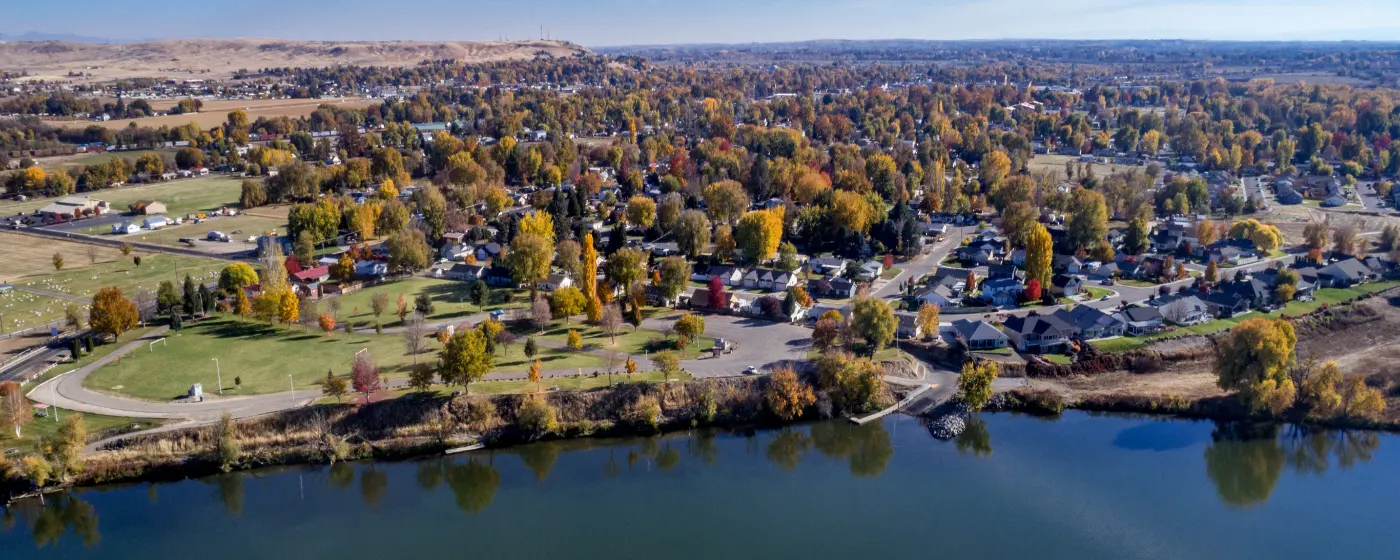
Most people researching Payette ask the safety question the same way: they pull up a website, see a score, and try to figure out if it's good or bad. The honest answer is that Payette sits in a nuanced middle ground — not the cleanest record in Idaho, but far safer than the national picture most people carry in their heads. For a city of about 9,000 people anchored between the Snake River and the Payette River confluence in Idaho's Treasure Valley, that context matters enormously.
The numbers that drive this city's safety profile come from federal crime reporting data collected by the Payette Police Department, whose 16 sworn officers operate out of 700 Center Avenue. The department runs a K-9 unit, a School Resource Officer embedded in local schools, and a Code Enforcement Specialist — a staffing structure that reflects a small city taking public safety seriously rather than leaving it to a skeleton crew. The Payette County Sheriff's Office layers on top of that with Neighborhood Watch initiatives and community education programs covering home security and identity theft prevention.
What six months of living here tends to clarify: property crime is the actual concern, not violent crime. The city's violent crime rate of 3.5 per 1,000 residents is effectively at the national average — CrimeGrade.org calls Payette "as safe as the national average" on that metric. Property crime at 10 per 1,000 sits modestly above Idaho's exceptionally low statewide rate, though it still runs well below what most of the country experiences. The bigger story is trajectory: the city's crime index fell 36% between 2023 and 2024, a drop that reflects both local policing efforts and a statewide trend — the Idaho Statistical Analysis Center reported the lowest total offense rate in two decades in 2024.
Whether you're considering a move or just trying to understand what the data actually means neighborhood by neighborhood, the sections below break down Payette's crime figures in context, explain where property crime tends to cluster, describe what the police presence looks like on the ground, and give you practical questions to ask before settling on a specific block or area.

Payette Crime Rates: What the Numbers Actually Mean
The Headline Figures in Context
Payette's violent crime rate of 3.5 per 1,000 residents and property crime rate of 10 per 1,000 residents are the numbers you'll see repeated across real estate and crime aggregator sites. Raw figures mean little without a frame of reference, so here's the comparison that actually matters.
| Geography | Violent Crime (per 1,000) | Property Crime (per 1,000) | Relative to Payette |
|---|---|---|---|
| Payette, ID | 3.5 | 10.0 | — |
| Idaho Statewide | 2.54 | 9.67 | Payette slightly higher on both |
| National Average | ~3.6 | ~17.6 | Payette at par / well below |
| Idaho ranking | — | Lowest in U.S. | Payette benefits from statewide context |
Sources: USAFacts/FBI UCR 2024 (published June 2026); SafeWise Idaho Safest Cities 2026 report.
What Locals Actually Notice
On violent crime, Payette is essentially average for the country — a 1-in-337 annual likelihood of experiencing a violent crime, per NeighborhoodScout's analysis of FBI 2024 data, is contextually comparable to many small Western cities of similar size. That figure tends to surprise people who assume a small Idaho city would be dramatically safer than national norms on this metric.
Property crime is the more relevant conversation. At 10 per 1,000, Payette sits just modestly above Idaho's statewide rate — but Idaho's property crime rate is the lowest of any state in the country. Measured against what most Americans are used to, Payette's property crime rate is still well below the national average of roughly 17.6 per 1,000. The practical concern here is vehicle break-ins and opportunistic theft rather than anything more serious — the pattern typical of small agricultural cities with a transient population passing through U.S. 95.
The most meaningful recent data point: the overall crime index dropped 36% from 2023 to 2024, and the five-year trend line shows decreasing violent crime alongside declining property crime. That kind of sustained movement matters more than any single year's snapshot.
Neighborhood Safety: Where Concerns Are Higher and Where They're Lower
Payette's six primary neighborhoods — Downtown Historic District, North End, Scotch Pines, South Payette, Centennial Park Area, and West Payette — don't carry individually published crime statistics, which means drawing precise block-by-block maps isn't possible from public data alone. What local pattern knowledge and general small-city dynamics do reveal is worth understanding before you decide on an area. For a fuller picture of what each neighborhood is like to live in day-to-day, see the best neighborhoods in Payette breakdown.
Downtown Historic District: Highest Foot Traffic, Most Visibility
The blocks surrounding the historic downtown along Main Street and 1st Avenue North see the most retail activity and the most police visibility. Higher foot traffic generally correlates with more reported incidents — a statistical reality that doesn't mean it feels unsafe. Opportunistic property crimes like vehicle break-ins are more likely here than in quieter residential pockets, simply because there are more vehicles and storefronts to target.
A handful of local restaurants along N Main Street and 3rd Ave S draw steady daytime and evening traffic — the kind of neighborhood anchors that keep sidewalks active during daylight hours, which tends to have a self-regulating effect on daytime crime.
Scotch Pines and the Centennial Park Area: Quieter by Design
The Scotch Pines neighborhood, anchored by Scotch Pines Golf Course on the city's west side, and the Centennial Park Area adjacent to Centennial Park tend to run quieter. These are established residential areas with lower density commercial activity, fewer late-night gatherings, and the kind of block familiarity that makes unusual activity easier to notice. Families with school-age children consistently cluster here for those reasons.
South Payette and West Payette: Worth a Closer Look
South Payette and parts of West Payette include older housing stock and some industrial adjacency near the agricultural processing corridor. These areas aren't dramatically different in safety terms, but older, more transient rental housing in any small city tends to correlate with slightly elevated property crime. Drive these streets at different times of day before deciding — the character shifts noticeably between daytime and evening hours.
North End: Established and Residential
The North End is among the more settled parts of the city, with tree-lined blocks and longer-term homeownership patterns. Kiwanis Park serves as a community gathering point here, and that consistent neighborhood presence tends to keep property crime lower than in more anonymous stretches of the city.
Best for: Families and longer-term residents who want a feel for the neighborhood before committing tend to find the North End and Centennial Park Area the most consistently quiet.
Property Crime: The Real Day-to-Day Risk
What Property Crime Looks Like at 10 Per 1,000
Property crime — theft, vehicle break-ins, and burglary — accounts for roughly three-quarters of all reported crime in Payette, mirroring the same ratio seen across Idaho counties. That 75/25 property-to-violent split is essentially the Idaho norm, and it frames what you should actually be thinking about when you evaluate personal safety here.
A rate of 10 per 1,000 means that in a city of approximately 9,000 people, roughly 90 property crime incidents are reported in a given year. That's a small absolute number. For comparison, cities in the Treasure Valley with more retail density and through-traffic — like Ontario, Oregon, just across the Snake River — report notably higher property crime per capita, driven in large part by highway-adjacent commercial strips.
Where Theft Tends to Happen
In small agricultural cities like Payette, property crime concentrates around a few predictable categories: unlocked vehicles (particularly trucks with tools or equipment visible), retail shoplifting in the commercial corridor along U.S. 95 and Main Street, and opportunistic theft from unlit parking areas after dark. Agricultural equipment theft in the rural stretches of Payette County is a separate concern that affects farms on the city's outskirts rather than residential streets.
The practical upshot: locking your vehicle and not leaving visible valuables in it eliminates your single highest risk factor. This isn't a city where you need to rethink your daily behavior — it's one where the basics of property security matter.
The Trend Line Is Encouraging
The 36% drop in the overall crime index from 2023 to 2024 aligns with a broader Idaho trend: the state's overall crime rate fell 8.7% between those same two years, and Idaho registered its lowest total offense rate in two decades. Payette's improvement outpaced even those favorable statewide tailwinds, which suggests local enforcement efforts are contributing independently of the macro trend.
Looking to buy in Payette? Estimate your payment.
Enter your numbers to see an estimated monthly mortgage payment.
Estimate only. Excludes HOA fees and mortgage insurance. The interest rate above is a starting point, not a quoted rate — replace it with your own to see real numbers. Insurance is a flat placeholder, not a Payette quote.
Police Department and Community Safety Programs
What 16 Officers Covers in a City of 9,000
The Payette Police Department operates out of 700 Center Avenue with 16 sworn officers — a ratio that works out to roughly 1.8 officers per 1,000 residents. That's a lean but not unusual staffing level for a small Idaho city, and it's supplemented by the Payette County Sheriff's Office, which covers the broader county including rural areas outside city limits.
The department's structure reflects deliberate community-policing priorities. The K-9 unit adds capability for narcotics and tracking situations without requiring additional sworn officers. An embedded School Resource Officer maintains a consistent, known law enforcement presence in local schools — something that matters both for safety incidents and for building the kind of community trust that produces better crime reporting and faster response to emerging problems.
Neighborhood Watch and Community Programs
Both the Payette Police Department and the Payette County Sheriff's Office run active Neighborhood Watch initiatives. These aren't passive programs — they include structured community education on home security hardening, identity theft prevention, and youth engagement. In a city where most blocks have the same faces year after year, Neighborhood Watch programs tend to function better than they do in high-turnover urban areas.
Identity theft and fraud education has become a notable program emphasis, which reflects a reality in small agricultural communities: financial crimes — particularly targeting older residents — are a growing concern nationally, and Payette's programs acknowledge that directly rather than focusing exclusively on street crime.
What Response Times Look Like
With 16 officers covering a geographically compact city, response times for priority calls are generally reasonable. The coverage area is small enough that most parts of Payette are within a few minutes of a patrol unit during active shifts. After-hours coverage becomes thinner, as it does in virtually every small city — which is one more reason the property-security basics matter here.
Practical Safety Research: What to Ask Before Choosing a Neighborhood
The Questions That Actually Matter
Crime statistics are a starting point, not a verdict. A city-wide rate of 3.5 violent incidents per 1,000 residents tells you something useful about Payette overall — it doesn't tell you whether the specific block you're considering is above or below that average. A few targeted steps will give you a much clearer picture.
Call the Payette Police Department directly at 700 Center Avenue and ask whether they publish a crime heat map or block-level incident data. Many small departments don't post this publicly but will discuss patterns when asked by a prospective resident. That conversation can surface things no aggregator website captures — whether a specific street has had repeated incidents, whether a particular corner near the commercial district draws problems after certain hours.
Ground-Truth the Block Yourself
Drive the streets you're considering at three different times: a weekday morning, a weekend afternoon when Centennial Park and Kiwanis Park are active, and a weeknight after 9 p.m. The character of a block changes across those windows in ways that daytime-only visits completely miss. South Payette and West Payette, in particular, reward this kind of multi-visit evaluation before settling on a specific area.
Talk to the neighbors. In a city of 9,000 people, the woman on the corner has probably lived there for a decade and will tell you exactly what she thinks about the block — including things that never get filed in a police report. This is genuinely more useful information than anything a crime aggregator site can give you.
Watch for the Specific Things That Aren't in the Data
The one thing that consistently surprises people who move to Payette from larger metro areas: agricultural equipment traffic on the roads adjacent to the city's eastern and southern edges creates a different kind of street dynamic than they're used to. This isn't a safety issue in the crime sense, but it changes the feel and the light conditions on those routes after dark. If you're considering a home near those corridors, that's worth experiencing firsthand, not just reading about.
The broader point is that Payette's crime figures — particularly the significant improvement in 2024 — paint a picture of a small city moving in the right direction. The context that Idaho as a whole recorded its lowest offense rate in two decades in 2024 makes that picture more meaningful, not less. Payette isn't a crime-free community, but the data doesn't support treating it as a concerning one either.
Local Expert Takeaway: Payette's safety story is really about property crime, not violent crime — and even the property crime rate sits well below national norms despite being modestly above Idaho's unusually low statewide figure. The 36% drop in the overall crime index from 2023 to 2024 is the number worth watching. For most people considering a move here, the practical calculus is simple: lock your truck, get to know your neighbors (the Neighborhood Watch programs make that easy), and walk the specific blocks you're considering at different times of day. The Centennial Park Area and North End near Kiwanis Park consistently feel the most settled. Downtown along Main Street is active and visible, not dangerous. The city is small enough that 16 officers at 700 Center Avenue genuinely know what's happening — that counts for something.
Quick Takeaways & FAQs
✅ Payette's overall crime index dropped 36% from 2023 to 2024, and Idaho recorded its lowest total offense rate in two decades that same year — the trend line here is meaningfully positive.
⚠️ Property crime at 10 per 1,000 is the honest concern: it runs modestly above Idaho's statewide rate and concentrates around vehicle break-ins and retail theft rather than residential burglary.
📍 The Payette Police Department's 16-officer force at 700 Center Avenue includes a School Resource Officer and a K-9 unit — a structure that punches above its weight for a city of 9,000.
Is Payette, Idaho a safe place to live?
How does Payette's crime rate compare to the rest of Idaho?
What type of crime is most common in Payette?
Which neighborhoods in Payette are considered the safest?
Does Payette have an active police presence?
Moving to Idaho?
Tell us what you need help with and we'll connect you with local resources.
