
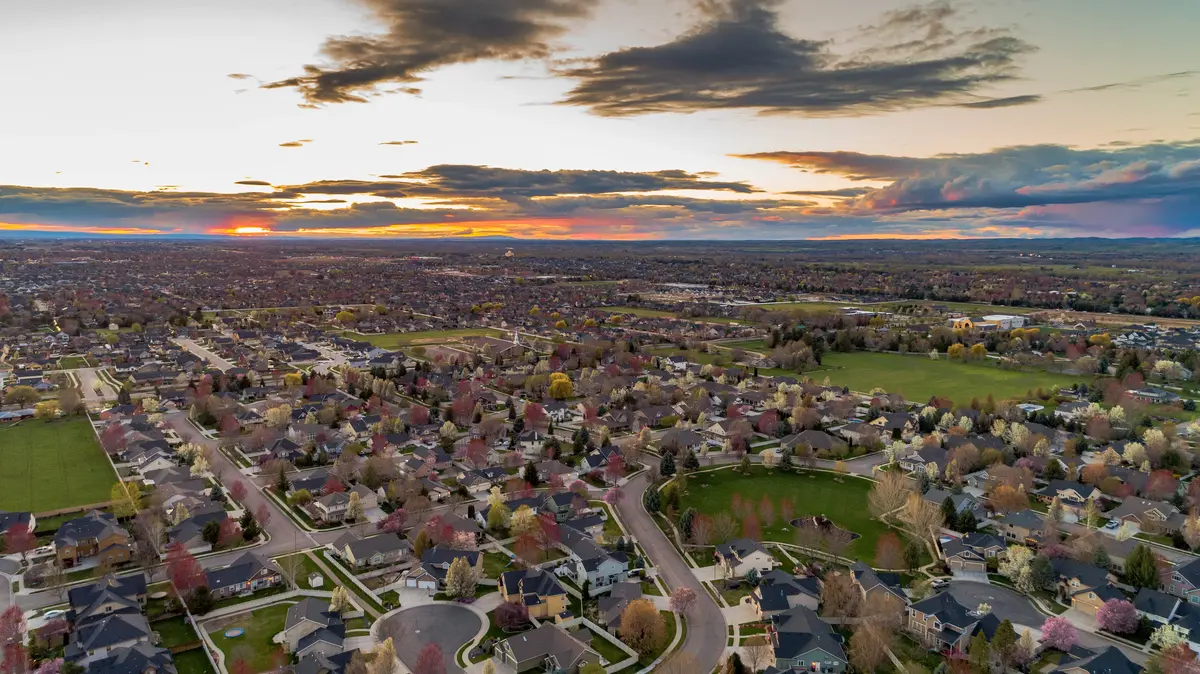
Maybe you've been priced out of Sacramento, or your Bay Area salary no longer justifies the cost of a two-bedroom in a suburb you can barely tolerate. Maybe you've watched colleagues quietly disappear to Idaho over the past three years and started asking questions. Meridian sits at the center of the Treasure Valley, just off Interstate 84 about 20 minutes west of downtown Boise, and it has become the landing pad of choice for Californians who want a real city's worth of infrastructure — national retailers, a growing range of medical services, new-construction neighborhoods — without paying California's price for any of it. The surprise isn't that people are moving here. It's how fast it happened: Meridian added nearly 22,000 residents between 2020 and 2024 alone.
The economic backbone here isn't a single tech campus or one dominant employer — it's a mix that insulates the city better than most. Scentsy, the direct-sales consumer goods company, is headquartered here and employs thousands. Blue Cross of Idaho operates its main offices in Meridian. That employer diversity matters when you're choosing a place to put down roots, not just park a remote salary. The West Ada School District, Idaho's largest, holds an A- rating, according to Niche — which is a meaningful signal for families arriving from California's uneven public school landscape.
The cost-of-living gap between California and Meridian is wide enough to change your monthly budget in ways that take a few months to fully feel. Idaho's overall cost of living index sits at 97.7 — just below the national average — versus California's 142.2. That translates to everyday expenses running roughly 31% cheaper on a like-for-like basis. The Treasure Valley isn't a wilderness outpost, either: Julius M. Kleiner Memorial Park gives families a genuine community gathering space, The Village at Meridian anchors shopping and dining, and Settlers Park connects to a trail network that runners and cyclists use year-round. What Meridian lacks in walkable urban density it makes up for in elbow room and a calendar of outdoor life that Californians from inland metros find immediately familiar.
Whether you're seriously considering a move or still running the numbers, the sections below break down the California-to-Meridian comparison on home prices, income and property taxes, sales tax, everyday costs, culture shift, and what the first year actually looks like.
Home Prices: What California Money Buys in Meridian
The number that stops most California buyers mid-sentence: Meridian's typical home value is $535,149 (Zillow Home Value Index, May 2026). California's statewide median sits at approximately $776,000 — and that figure includes the Central Valley and the Inland Empire pulling the average down. In coastal markets like the Bay Area, Los Angeles, or San Diego, the median is dramatically higher.
What that means practically is that a budget that bought you a $1,400-square-foot starter home in Fresno or a condo in Sacramento can get you a 2,000-square-foot, four-bedroom home with a three-car garage in a Meridian subdivision — often with a community pool and a greenway trail out the back fence.
What $500K–$700K Actually Gets You
In Meridian's established neighborhoods like Paramount or BridgeTower, that price range lands you in newer construction with open floor plans, granite counters, and landscaped yards in planned communities that don't feel like compromises. Spurwing Greens and Cedar Creek attract buyers who want proximity to the Spurwing Country Club golf corridor without the country-club price tag. These are neighborhoods where your California equity check — if you're selling and moving — can eliminate your mortgage entirely or come close.
Entry-level options do exist below the city median, particularly in older pockets near the Meridian Road corridor. For a deeper look at how neighborhoods compare by character and location, the Meridian neighborhoods guide has the full breakdown.
| Scenario | California | Meridian, Idaho |
|---|---|---|
| Statewide / city typical home price | ~$776,000 (statewide median) | $535,149 (Zillow Home Value Index, May 2026) |
| Effective property tax rate | ~0.70% (Prop 13 may lower this for long-tenured owners) | 0.76% |
| Approximate annual tax bill at respective medians | ~$5,432 | ~$4,067 |
| New buyer's assessed value reset | Yes — resets to purchase price at sale | Yes — assessed at purchase price |
| 2-BR apartment average (statewide) | $2,745/month | $1,410/month (Idaho) |
| Cost of living index | 142.2 | 97.7 (Idaho) |
One thing California buyers frequently miss: Meridian's property tax rate at 0.76% is nearly identical to California's nominal rate of ~0.70%. The difference shows up in the dollar amount — lower home prices mean a lower annual bill even at a comparable rate.
If you're a long-tenured California homeowner whose Proposition 13 assessed value is still anchored to a purchase price from a decade ago, your current effective rate may be well below 0.70%. Selling and buying in Meridian resets your assessed value to the purchase price — so model that correctly before you celebrate the rate comparison. For more on the full Meridian cost-of-living picture, including utilities and groceries, that page has the detail.
Income and Sales Tax: The Real Numbers Side by Side
Idaho's income tax story got better in early 2025. Governor Brad Little signed HB 40 on March 6, 2025, dropping Idaho's individual income tax to a flat 5.3% on all taxable income — the largest income tax cut in state history, returning an estimated $253 million to taxpayers. California's top marginal rate sits at 13.3%.
At moderate incomes, the gap is real but not dramatic. At $100,000 in taxable income, Idaho's flat 5.3% produces a bill of approximately $5,300 versus roughly $5,762 under California's progressive brackets — a difference of about $462 per year. The math changes significantly as income climbs.
| Income Level | California Tax Bill (est.) | Idaho Tax Bill (est.) | Annual Idaho Advantage |
|---|---|---|---|
| $100,000 | ~$5,762 | ~$5,300 | ~$462 |
| $250,000 | ~$26,413 (est.) | ~$13,250 (est.) | ~$7,413 |
| $500,000 | ~$56,413 (est.) | ~$26,500 (est.) | ~$23,913 |
Estimates based on countrytaxcalc.com California vs. Idaho comparison, May 2026. Consult a tax professional for your specific situation.
The Sales Tax Wrinkle Californians Miss
Idaho's statewide sales tax is a flat 6% with no local-option additions — unlike California's 7.25% base rate that climbs higher in many counties and cities. That said, Idaho applies its full 6% to groceries, where California exempts unprepared food entirely.
Idaho partially offsets the grocery tax with a refundable Food Tax Credit of $155 per person per year — raised from $120 in the 2025 legislative session — plus an alternative credit of up to $250 per person if you submit actual grocery receipts. For a family of four, that's potentially $620 to $1,000 back annually. It doesn't fully close the gap for large families with high grocery bills, but it softens the hit considerably.
The net sales-tax picture still generally favors Idaho for most households, especially those spending heavily on big-ticket non-grocery purchases. The IRS's own migration data for 2022–2023 shows California losing approximately 100,397 net tax filers and $11.9 billion in adjusted gross income to other states — and Idaho has been a consistent top per-capita destination throughout that period. The tax structure is a major reason why.

What the Culture Shift Actually Feels Like
Six months in, almost every California transplant says a version of the same thing: they didn't expect how much they'd miss density. Not the traffic — nobody misses that — but the proximity of things. The ability to find a specific cuisine, a specific shop, or a specific experience within a 10-minute drive. Meridian is a suburb built around the car, and if your California life was in a walkable neighborhood in Oakland or Pasadena, the adjustment is real.
What replaces it is space, and community in a different form. Families gather at Julius M. Kleiner Memorial Park on weekend mornings in a way that feels genuinely neighborly — it's a 60-acre park with a lake, a splash pad, and enough room that it doesn't feel crowded even when it's busy. The Friday-evening scene near The Village at Meridian is where you'll spot the mix that defines the city now: longtime Idaho families, remote workers in Patagonia vests, and parents with strollers navigating the outdoor retail corridor.
Political and Social Climate
Idaho is a reliably conservative state, and Meridian is no exception. If you're moving from a politically progressive California metro, expect a visible shift — in local election results, in the dominant conversation at neighborhood gatherings, in the way schools approach certain topics. This isn't a dealbreaker for most transplants, but it's a real adjustment for some, and the ones who struggle most are the ones who didn't think about it before signing the closing docs.
The flip side: there's a libertarian streak in Idaho that values being left alone, and many California transplants — especially those who felt over-regulated — find that genuinely refreshing. Gun culture is visible and normalized. Outdoor recreation isn't a weekend hobby; it's the social currency. If hunting, fishing, and trail running aren't already part of your life, you'll find that they quickly become the easiest way to build friendships here.
Winter Is Not Symbolic
Californians moving from the Bay Area or coastal Southern California routinely underestimate Boise-area winters. Meridian averages around 20 inches of snow annually — not brutal by Midwest standards, but enough that you'll need to think about snow tires, ice scrapers, and the fact that school is rarely canceled even when roads are rough. The summers are dry and hot, regularly hitting 100°F in July and August, which feels familiar if you're from the Central Valley and comes as a shock if you're from the coast.
Looking to buy in Meridian? Estimate your payment.
Enter your numbers to see an estimated monthly mortgage payment.
Estimate only. Excludes HOA fees and mortgage insurance. The interest rate above is a starting point, not a quoted rate — replace it with your own to see real numbers. Insurance is a flat placeholder, not a Meridian quote.
Who Moves Here — and Who Regrets It
Meridian ranked 71st among the 100 fastest-growing U.S. cities between 2020 and 2024, adding nearly 22,000 residents in four years. Ada County alone added more than 10,000 residents in 2025. The people arriving aren't a monolith — but there are recognizable patterns.
The Profiles That Tend to Land Well
Remote workers with California salaries are the most economically obvious fit: same income, dramatically lower housing cost, no state income tax penalty (Idaho's 5.3% flat rate is still well below what high earners pay in California). Families with school-age children are another natural fit — the West Ada School District is Idaho's largest, and its strong academic profile consistently draws parents who prioritize public education.
Californians who grew up in suburb-first environments — the Inland Empire, the Central Valley, the South Bay — tend to adapt the fastest. They already know how to live car-dependent lives. The adjustment isn't the lifestyle; it's the pace, which is slower in ways that sneak up on you.
Who Tends to Move Back
The people who leave Meridian after a year or two usually cite one of three things: the cultural isolation from California's diversity and density, the absence of a genuine urban core within walking distance, or the winters. A subset of former residents leave because they miss proximity to family still in California — the drive back is long, and Southwest's Boise routes fill up fast around holidays.
A specific honest note: if your plan is to live in one of the far-eastern subdivisions off Eagle Road near Chinden Boulevard and commute into Boise daily, budget time as well as money. That stretch of Chinden is a genuine chokepoint during morning rush — westbound from Eagle Road into Meridian and eastbound from Meridian into Boise between 7:30 and 9:00 a.m. can add 15–20 minutes over what navigation apps predict on a light day. Learn the back route through McMillan Road early.
People who move here expecting a smaller, cheaper version of California's urban experience will be disappointed. Those who move here expecting a different kind of life — with a yard, a garage, summer evenings on a back deck, and a school their kids can walk to — almost universally describe the move as the right call. See the full breakdown of who Meridian suits and why.
Practical Checklist Before You Sign the Papers
California buyers arrive with assumptions baked in from years of operating in a specific market. Some transfer directly to Meridian. Several don't.
Things That Work Differently Here
- Title companies, not escrow companies: Idaho real estate closings run through title companies. If you're used to California's escrow-centric process, the workflow is similar but the terminology and the players are different. Ask your agent to walk you through the Idaho closing timeline early.
- No transfer tax: Idaho does not charge a real estate transfer tax. California's documentary transfer tax added a non-trivial line item to every closing. Here it doesn't exist.
- Homeowner's exemption: Idaho offers a homeowner's exemption that reduces the taxable assessed value of your primary residence. File with the Ada County Assessor's office after closing — it's not automatic, and missing the deadline means waiting a full year.
- Water rights and HOAs: Many Meridian subdivisions have irrigation districts managing outdoor water, separate from your domestic water bill. HOA rules in planned communities like Paramount and BridgeTower are enforced actively — read the CC&Rs before you fall in love with the house.
- Wildfire smoke season: August and September bring smoke from regional fires, some years more than others. If respiratory health is a consideration for your family, factor in that Boise-area air quality can drop to unhealthy ranges for days at a time during peak smoke events — something California coastal transplants in particular rarely anticipate.
What to Do in the First 90 Days
Get your Idaho driver's license within 90 days of establishing residency — Idaho requires it, and the DMV in Meridian on East Fairview Avenue moves faster than most California DMVs but still has real wait times. Register your vehicles at the same time. Update your voter registration if that matters to you — Idaho has same-day registration, which is genuinely convenient.
Spend a Saturday walking the downtown corridor around Carlton Avenue and Main Street before committing to a neighborhood on the city's outer edges. Loose Screw Beer Co. on E. Carlton Ave and Voodoo Brewing Co. on N. Main St. are both worth an afternoon — they're where you'll start to meet the mix of longtime locals and recent arrivals who make up the actual social fabric of the city. The Meridian of five years ago was quieter; what's here now is something actively being built, and arriving with that mindset — rather than with nostalgia for somewhere else — makes all the difference.
For neighborhood-level detail on which areas fit which lifestyles, the Meridian neighborhoods guide breaks down each community by character and commute. For a full read on what safety looks like across different parts of the city, see the Meridian safety page.

Local Expert Takeaway: The California transplants who thrive in Meridian tend to arrive with a specific mindset: they came for the financial math and stayed for the lifestyle reset. The ones who struggle arrive expecting a cheaper version of where they left. Julius M. Kleiner Memorial Park on a Saturday morning, a craft beer at Loose Screw on Carlton Ave, a school pickup in a West Ada elementary parking lot — these are the daily textures of Meridian. They're not what you had before. That's the point.
Quick Takeaways & FAQs
✅ Idaho's flat 5.3% income tax rate means high-earning California transplants can save tens of thousands of dollars annually compared to California's top 13.3% marginal rate.
⚠️ Meridian is a car-dependent suburb with no walkable urban core — transplants from dense California neighborhoods typically need 6–12 months to adjust to the pace and layout.
📍 The Ada County homeowner's exemption reduces your taxable assessed value but must be filed manually with the county assessor after closing — it's not automatic.
How much cheaper are homes in Meridian compared to California?
Does Idaho really have no income tax advantage over California for average earners?
Does Idaho tax groceries? I've heard it does, unlike California.
How is the commute from Meridian to Boise?
What's the biggest culture shock California transplants report after moving to Meridian?
Moving to Idaho?
Tell us what you need help with and we'll connect you with local resources.
